A low unit price looks attractive until the MOQ multiplies across three designs and your cash sits in cartons for a season.
Expect crystal award wholesale MOQ to be set per design and size—often around 100 pieces in our catalog—and judge it as cash-at-risk against your sell-through and next-30-day cash forecast, not as a single magic number.

Below I explain what MOQ usually covers, how to size it like a retailer, when blanks or samples beat variety, and which written terms must sit beside the piece count.
What Does Wholesale MOQ Actually Mean for Crystal Awards?
Shops often ask for “the MOQ” as if one number covers the whole catalog. In crystal awards, the number usually attaches to a specific model.
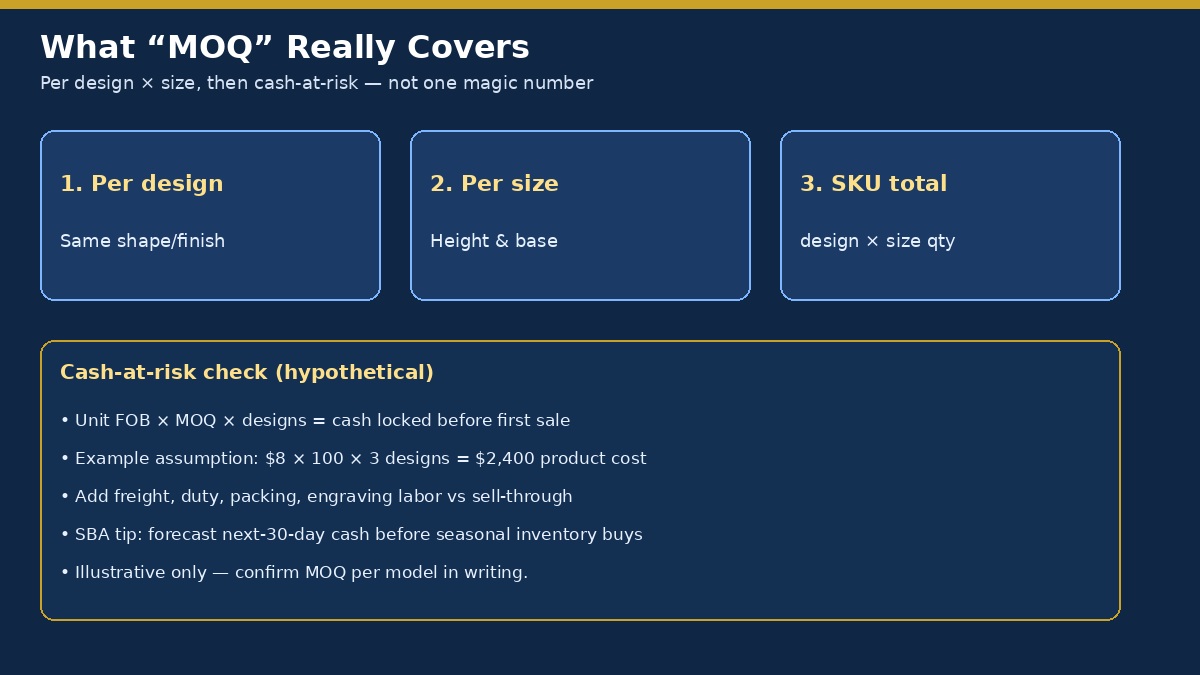
Wholesale MOQ for crystal awards is typically a minimum quantity per design and size. Ordering five designs means five minima, not one shared bucket of pieces.
Separate piece count from SKU count
When a supplier says the MOQ is 50 or 100, ask: per design, per size, or per shipment? Crystal and glass awards are handmade or semi-handmade in most export lines, and tooling, polishing, and packing are organized by model. That is why a second height or a second base color often restarts the minimum. In our own wholesale practice at GLORY AWARD & TROPHY, the crystal trophy MOQ is about 100 pieces per design and size, with more than 1,000 ready-made designs available for shops that prefer catalog models over full OEM.
Public competitor catalogs sometimes quote lower figures—for example, 50 pieces per model on blank-focused sites—but those figures are not a market rule. Treat every published MOQ as a starting claim to confirm in the quotation, not as proof that your supplier must match it.
Translate MOQ into cash at risk
The useful question is not “Is 100 high?” It is “How much cash does this MOQ lock before the first engraving job pays?” A simple check is:
| Input | What to write down |
|---|---|
| Unit FOB or EXW price | From the written quote |
| MOQ per design × size | From the same quote |
| Number of designs in the first order | Your assortment plan |
| Freight + insurance estimate | Named Incoterm dependent |
| Duty / brokerage placeholder | Importer responsibility |
Hypothetical example (not a quote): if FOB is $8, MOQ is 100, and you take three designs, product cost alone is $2,400 before freight and duty. That math is why “cheap per piece” can still be expensive for a family trophy shop.
Why catalogs look flexible while MOQs feel rigid
Ready-made designs make browsing easy, but production still batches by model. OEM/ODM adds sample and mold steps. Over 80% of our products are handmade with a typical production window of about 20–30 days after approval, so the first deposit also buys calendar time, not only glass. Knowing that timeline helps you avoid ordering five slow SKUs just to “fill a container story” that your cash cannot support.
How Do You Size MOQ Against Inventory Turnover and Cash Flow?
Trophy shops are retailers with engraving capacity. The MOQ decision is an inventory decision first.
Size the first wholesale MOQ to SKUs you already sell, then check a 30-day cash forecast so product sitting on the shelf does not starve payroll and freight.

Use retailer KPIs, not factory folklore
The U.S. Small Business Administration recommends reviewing inventory turnover—what sells quickly versus what languishes—when you plan buying cycles. It also stresses a monthly cash-flow forecast: your checking balance plus expected receipts and payments over the next 30 days. That pair of KPIs is more honest than asking whether an MOQ “sounds normal.”
If a crystal plaque turns every two weeks during sports season but a tall pillar sits for months, the plaque can justify an MOQ while the pillar should stay at sample quantity. Shops that ignore turnover often show profit on paper while cash is trapped in cartons.
Build a one-page MOQ sizing sheet
Before you deposit, write four numbers for each candidate SKU:
- Units sold in the last 90 days (or a conservative seasonal estimate).
- Weeks of cover you want after the shipment arrives.
- MOQ offered for that design and size.
- Cash outlay = unit landed estimate × MOQ.
If MOQ coverage exceeds what you can sell before the next buying window, either drop the SKU, switch to a blank that supports multiple end-customer jobs, or wait for a deposit from a corporate/sports order before you commit.
Import cash is part of the MOQ
U.S. Customs and Border Protection states that importers share responsibility for compliance and should understand the rules that apply to their goods. For many decorative glass articles, the U.S. International Trade Commission Harmonized Tariff Schedule Chapter 70 places glassware of a kind used for indoor decoration or similar purposes under heading 7013, with several lines further split by unit value. Exact classification needs care for each article, but the practical point for MOQ planning is simple: duty and brokerage are cash that leaves with the shipment, so they belong in the same worksheet as the piece count.
Do not treat freight-inclusive marketing language as a substitute for a named Incoterm. The U.S. International Trade Administration Incoterms overview explains that Incoterms allocate tasks, costs, and risk transfer—but they do not set price, payment timing, or liability for goods that fail to conform. Your MOQ conversation should therefore include both the piece minimum and the term that decides when risk and cost move.
Should You Split Across Designs, Order Blanks, or Start with Samples?
Variety feels safe for the showroom. For cash flow, concentrated SKUs or blanks often win the first import.
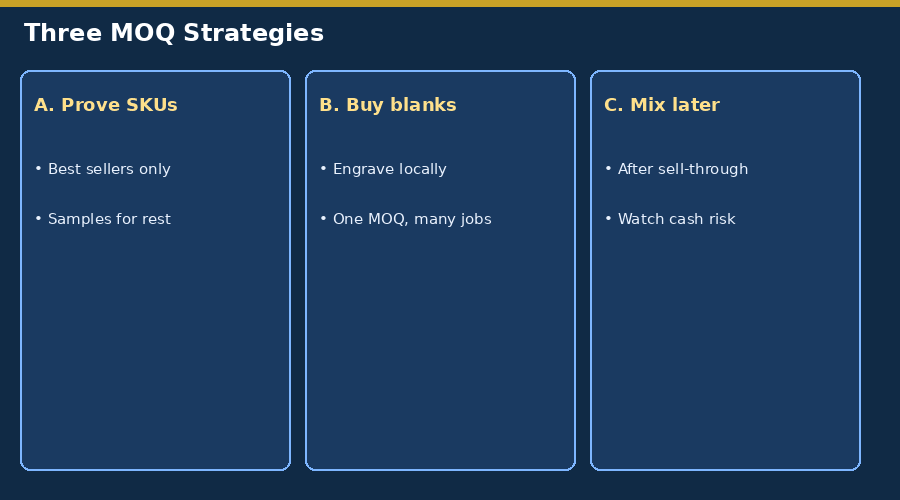
For a first wholesale order, prove one or two fast SKUs or buy engravable blanks; splitting many designs at full MOQ multiplies cash risk before you have sell-through data.
Path A — Concentrate on proven sellers
List the awards your shop already reorders: school MVP, corporate rectangle plaque, star tower. Put MOQ budget on those first. Keep slower shapes as display samples. This path fits shops that engrave locally and need predictable blanks or finished stock.
Path B — Prefer blanks when personalization is your margin
Blank glass and crystal pieces let one MOQ support many end customers because names and logos are added after arrival. That is why blank glass trophies and jade glass awards for engraving often make more sense than pre-decorated SKUs for a small shop. Browse our glass awards and crystal trophies with that filter in mind: can this model take your local engraving process cleanly?
Path C — Mix designs only after data
Mixing five designs at 100 each looks like a full shelf, but it is five inventory bets. Use this path after you have turnover data or firm customer deposits. OEM shapes add sample approval and longer lead time, so they belong behind a clear buyer order whenever possible.
| Strategy | Best when | Main risk |
|---|---|---|
| Concentrate 1–2 SKUs | You already sell those shapes | Shelf looks narrower at first |
| Buy blanks | You engrave in-house | You must confirm engraving area and thickness |
| Multi-design MOQ | Deposits or proven turnover exist | Cash multiplies by each design’s minimum |
| Sample-first | New supplier or new shape | Adds days before bulk production |
Sample before you scale the MOQ
A sample is not a loophole around MOQ; it is a quality lock. Approve the glass clarity, base fit, packing, and engraving test on one piece, then apply the MOQ to that locked specification. Skipping the sample to “save time” often creates a larger write-off when 100 pieces miss the mark.
What Written Terms Belong Next to the MOQ Number?
An MOQ without terms is only a piece count. The terms decide how much risk that count carries.
Put MOQ in the same written quote as design/size, sample approval, Incoterm, lead time, packing, payment stages, and the remedy if goods do not match the approved sample.

The MOQ line item checklist
Ask the supplier to state, in one quotation or PI:
- MOQ per design and size, plus whether mixed sizes share a minimum.
- Unit price tiers, if any, above the MOQ.
- Production lead time after sample/artwork approval (our typical window is about 20–30 days for handmade crystal lines).
- Packing method per piece and per carton.
- Named Incoterm and place (for example FOB named port, or another agreed rule).
- Deposit and balance timing.
- How pre-shipment photos or video confirmation work.
- What happens if the bulk lot differs from the approved sample.
Incoterms clarify cost and risk—not payment disputes
According to the U.S. International Trade Administration, Incoterms® 2020 are eleven rules that define who handles carriage, insurance, export/import formalities, and when risk transfers. Equally important is what they leave out: contract price, payment method, title transfer, and liability when goods do not conform. So if your MOQ quote only says “FOB” without the rest, you still have open risk on quality disputes and payment timing.
Import compliance sits with the buyer of record
CBP’s basic importing guidance reminds importers that compliance is a shared responsibility and that commodity-specific rules may apply. Pair that with the USITC Chapter 70 text when you talk to your broker about decorative glassware classification. Your MOQ worksheet should leave a line for duty assumptions instead of pretending the unit FOB is the landed cost.
How we usually answer MOQ questions
With 23 years of export experience serving overseas trophy shops, we expect MOQ questions early. Tell us which blank or finished models you want, whether you will engrave locally, and your target in-hand date. We can then confirm the per-design minimum, sample options, and shipping term in writing before any deposit. That keeps the MOQ number attached to a workable plan instead of a hopeful catalog screenshot.
Conclusion
Judge crystal award MOQ as cash-at-risk per design and size, match it to sell-through and a 30-day cash forecast, then lock sample, Incoterm, and remedy in writing before you deposit.
