A carton can look intact while a crystal star arrives with a chipped tip—because transit damage starts inside the pack, not on the label.
Keep crystal trophies intact by treating packing as a layered system—gift box, individual cushioning, rigid double-boxing, and written damage criteria—then validate that system before you scale an international order.

Below I break down why “looks fine” cartons still fail, which carrier packing rules matter, how to validate before MOQ, and what to do when a piece still breaks.
Why Do Crystal Trophies Break in Transit Even When Boxes Look Fine?
Buyers often judge a shipment by the outer carton. Crystal fails at edges, tips, and glued joints long before the box looks crushed.
Outer cartons can survive while crystal chips because drops, vibration, and shifting load energy into unprotected corners unless the product and pack are tested as one system.
Glass is a fragile product class, not a special sticker class
The ISTA 3A overview defines fragile products as items that could easily break when dropped without protective packaging and explicitly lists glass among the examples. Crystal trophies—stars, icebergs, plaques—concentrate stress at tips, thin walls, and base joints. A “Fragile” label does not change those physics, and it does not replace cushioning thickness or void control.
ISTA also tells the shipper to decide before testing what counts as product damage, what tolerance is allowed, how inspection will be done, and what package condition is acceptable. That is the practical lesson for trophy shops: if you never defined “chip on tip vs. hairline on base,” you cannot judge packing success or supplier responsibility after arrival.
Why intact outer boxes still hide broken awards
Parcel networks combine drops and vibration. ISTA’s 3-Series procedures exist to simulate those damage-producing motions for transport environments. Inside a carton, a crystal piece can migrate toward a corner, bang against a neighboring base, or load its own gift-box lid like a lever. The master carton may still look square.
Common failure modes I see in wholesale crystal packing reviews:
- Product rattles inside the gift box, so every vibration becomes a micro-impact.
- Soft wrap exists on faces but corners and star tips are under-protected.
- Multiple awards share one cavity without partitions, so pieces strike each other.
- Voids settle during long ocean or rail legs, then a last-mile drop finishes the chip.
Separate cosmetic carton damage from product damage
A dented outer shipper is a signal, not a verdict. Open carefully, keep all materials, and inspect tips, engraving faces, and base adhesion under good light. Photograph the item still nested in its inner pack when possible. That evidence trail matters later for carrier claims and for supplier replacement decisions.
With 23 years of exporting awards to overseas trophy shops, we treat packing and inspection as part of the product—not as an afterthought once production finishes.
What Packaging System Actually Protects Crystal Awards in Parcel and Freight Moves?
Hope is not a cushion. Carrier packaging guides describe a repeatable stack: wrap, center, fill voids, then double-box.
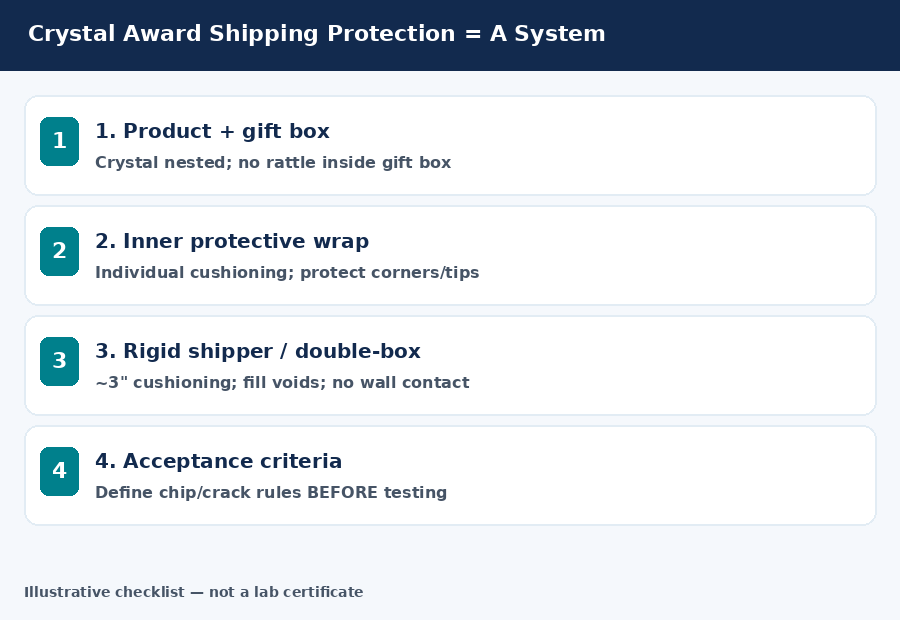
Protect crystal awards with individual cushioning, no movement inside the gift box, and a double-box outer shipper that keeps about three inches of cushioning around the inner pack.

Build four layers, not one “strong box”
A workable crystal packing system usually has four layers:
- Product seated in its presentation/gift box so the piece cannot rattle.
- Individual wrap for each award, with extra attention to tips and corners.
- Rigid outer shipper, preferably a double-box for fragile geometry.
- Written acceptance criteria so inspectors know what “pass” means.
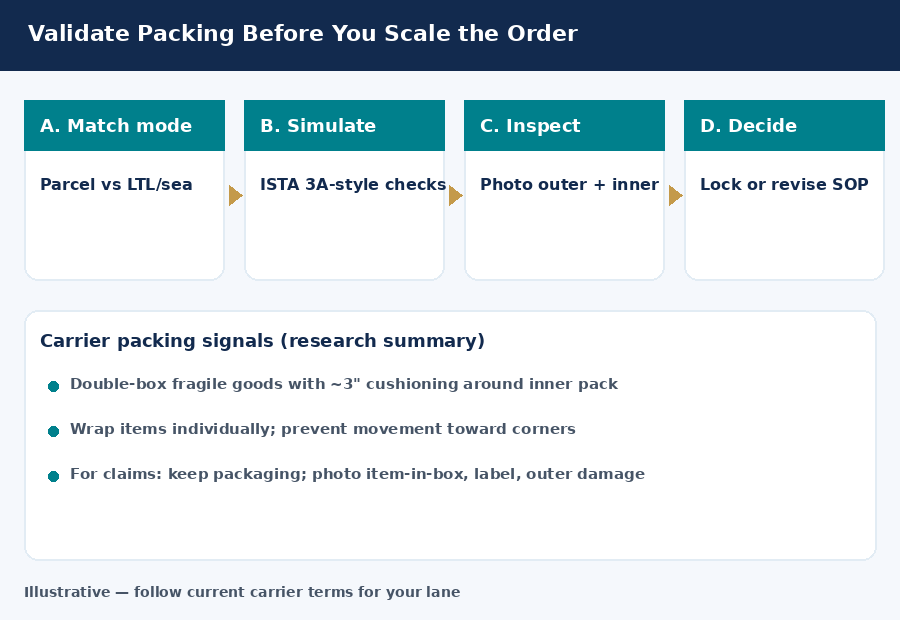
Major parcel carriers publish similar breakables rules: double-box fragile items, keep roughly three inches of cushioning around the inner pack, wrap pieces individually, center the product so it cannot migrate, seal seams firmly, and place the label on the largest face rather than across tape. Those operational rules align with treating the award and its carton as one system—the same stance ISTA 3A takes when it evaluates packaged-products for parcel delivery.
Carrier packaging guides also describe a two-box geometry for sharp or fragile goods: an outer carton several inches larger in each dimension than the inner pack, with cushioning filling the gap, separate wraps for each item, and rigid new cartons instead of soft over-wrap. The same guides commonly point shippers toward performance testing such as ISTA 3A rather than relying on a “Fragile” sticker.
Match packing to geometry
| Crystal geometry | Extra packing focus | Why it matters |
|---|---|---|
| Star / pointed top | Tip caps + side support | Tips take first contact in a tip-over |
| Tall tower / pillar | Lateral bracing, no lean | Tall parts act like levers under vibration |
| Plaque / flat panel | Edge guards, face pads | Edges chip; faces scratch |
| Iceberg / irregular | Custom void fill around facets | Uneven faces migrate into hard contact |
| Multi-piece set | Partitions, one cavity per piece | Piece-to-piece impact is common |
Browse our crystal trophies and glass awards with packing in mind: can this shape be immobilized without pressing on a thin face?
Presentation boxes are not shippers
Colored, white, velvet, or leather gift boxes help retail presentation, but they rarely replace a corrugated shipper. Nest the gift box, then cushion that assembly inside the transport carton. For wholesale cartons with many units, add partitions so one broken piece cannot cascade damage across the layer.
Mode changes the hazard profile
Express parcels emphasize drops and sorting shocks. Sea and rail add long vibration and stacking time. Door-to-door service and optional insurance can reduce administrative pain, but they do not excuse weak inner packing. Ask your supplier to describe the inner method—not only the courier name—before you approve a bulk ship date. Use the ISTA procedure index to name the hazard class you care about (parcel 3A versus broader 3-Series simulations) so both sides share vocabulary.
How Should You Validate Packing Before You Scale an International Order?
Scaling MOQ before you prove the pack is how shops buy one hundred chips instead of one sample lesson.
Validate packing on a sample or pre-production carton with photos and clear pass/fail criteria, then lock that SOP before you multiply quantity across designs.
Use simulation language buyers and suppliers share
ISTA positions 3-Series tests as general simulations of transport hazards. For individual packages at or under 150 lb / 70 kg moving through parcel systems, ISTA 3A is the common reference. You do not need to become a packaging lab to use the idea: treat product and package together, define damage up front, and prefer more than one sample when the product is fragile—ISTA’s overview recommends two or more packaged-product samples for fragile types such as glass.
That gives trophy shops a neutral sentence for a purchase discussion: “Please confirm the pack method you will use and whether it has been checked against a parcel simulation like ISTA 3A.” Carrier packaging literature often echoes the same test pointer; keep the conversation on the test intent and your written pass/fail criteria rather than on sticker language.
A practical validation path for trophy shops
- Approve the sample pack — one finished award in the exact gift box and shipper you will use for bulk.
- Ship or drop-test a pilot — a paid sample shipment to your shop, or a lab/3PL drop sequence if volume justifies it.
- Inspect with a checklist — tip chips, face scratches, base looseness, carton crush, moisture marks.
- Photograph the nesting — item in inner pack, partitions, and outer closure.
- Lock the SOP in writing — materials, cushion thicknesses, units per carton, orientation marks.
- Only then scale MOQ — across designs and sizes.
Pre-shipment confirmation reduces surprises
Ask for pre-shipment photos or short videos of packed cartons, not only beauty shots of the awards. Multi-stage QC should include a clean-and-check step before packing and a packed-state confirmation before handoff to the courier or freight forwarder. If the packed photo shows voids or tip contact with a wall, stop and revise before the full lot moves.
When ocean or LTL is the main leg
Parcel-oriented 3A thinking still helps for last-mile pieces, but unit loads may need additional compression and handling checks. Tell your supplier the real door-to-door path—express, sea, or railway—so they do not pack a parcel sample and then compress the same method into an overloaded export carton. Insurance can sit beside the plan; it is not a substitute for the plan.
Hypothetical note (not a quote): if one damaged award costs a lost ceremony date plus a remake, spending a sample shipment to prove the pack is usually cheaper than discovering failure after a 100-piece MOQ lands.
What Should You Do When a Crystal Trophy Still Arrives Broken?
Even good systems fail sometimes. Speed and evidence decide whether you recover the piece—or only argue about it.
Keep the packaging and contents, photograph the nested damage, notify the carrier and supplier immediately, and use written replacement terms so a remake can travel with the next shipment.

Preserve the evidence the claim process expects
When a crystal award arrives damaged, keep the contents and the packaging until the claim and supplier review are finished. Carrier claim workflows commonly ask for photos of the damaged item as packed inside the box, a clear view of the shipping label, and the outer carton condition, plus basic box dimensions. Start the claim promptly under the rules for your lane—many networks use a short window from the scheduled delivery date. Those documentation habits also explain why packing quality matters: carriers themselves often attribute damage claims to cartons that are too large or too small, thin cushioning, or poor label placement.
Do not throw away foam, partitions, or the gift box early. Those materials show whether the product shifted or whether a corner was unsupported. Pair the photos with your order number and a short description of which tip, face, or base joint failed.
Parallel tracks: carrier claim and supplier replacement
Open the carrier claim when your Incoterm and shipping account make you the claimant. In parallel, send the supplier clear photos/video of the damage and the packing state. In our wholesale practice at GLORY AWARD & TROPHY, damaged or defective pieces can be replaced free of charge with the next shipment after photo or video proof. That path does not erase the need for better packing; it minimizes lost sellable stock while you correct the system.
Write the replacement rule before you need it
Put these points next to packing terms on the PI or order confirmation:
- How quickly damage must be reported after delivery.
- What proof is required (photos of item, inner pack, outer carton, label).
- Whether replacements ship free with the next order or as a standalone remake.
- Who files the carrier claim under the named Incoterm.
- Whether insurance was purchased for the move.
Close the loop so the next carton is safer
After a breakage event, update the pack SOP: add tip caps, increase cushion thickness, reduce units per layer, or change carton grade. Then validate again on a small quantity against the damage definitions you set using ISTA 3A thinking—product and package together. A claim payment without a packing change simply schedules the next chip.
If you are planning a first import of crystal trophies, ask us to confirm packing method, insurance options, and the replacement path in writing before deposit. That keeps breakage from becoming a surprise margin killer during award season.
Conclusion
Protect crystal trophies with a layered, validated packing system and written damage criteria—then document breakage fast so remakes and claims can work.
