A beautiful wood plaque blank that warps, burns unevenly under your laser, or arrives oversize will still cost you a full reorder—and your client’s event date.
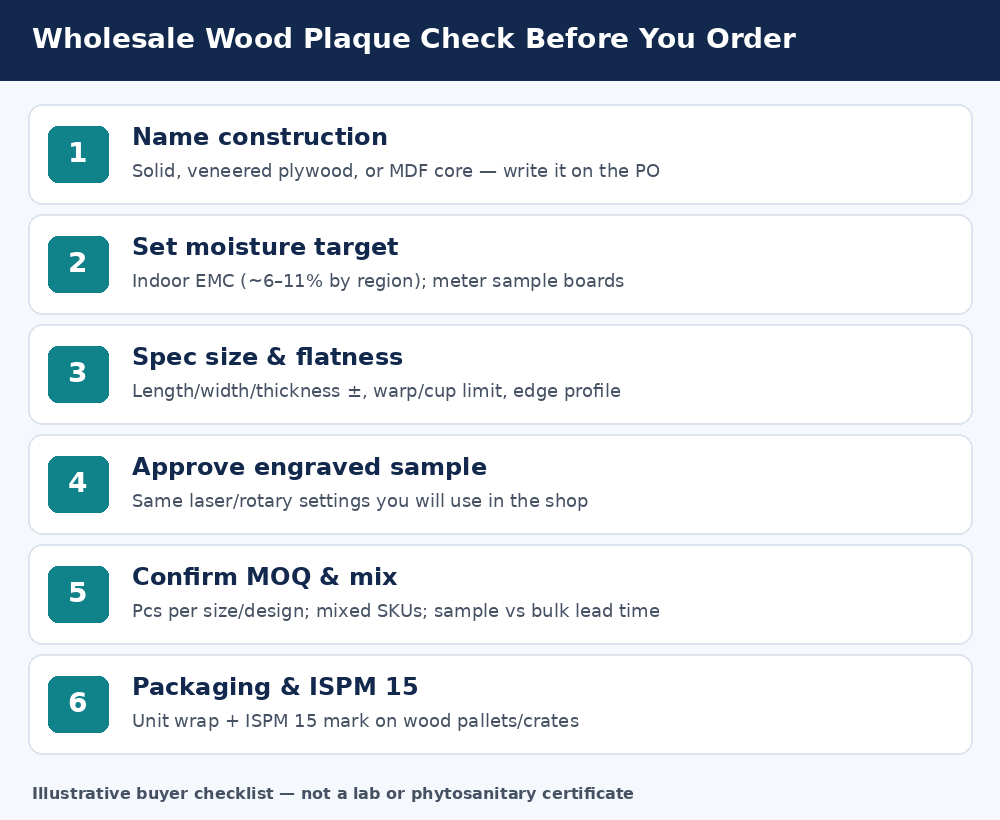
Check construction (solid, veneered or MDF), target moisture for your indoor climate, size/flatness tolerances, an engraved sample under your own settings, MOQ/mix rules, and ISPM 15 packaging—before you lock a wholesale order.

Below I break those checks into construction, moisture and laser behaviour, PO tolerances, and how MOQ, mix and packaging interact.
Solid Wood, Veneer or MDF Core—Which Construction Survives Engraving and Humidity?
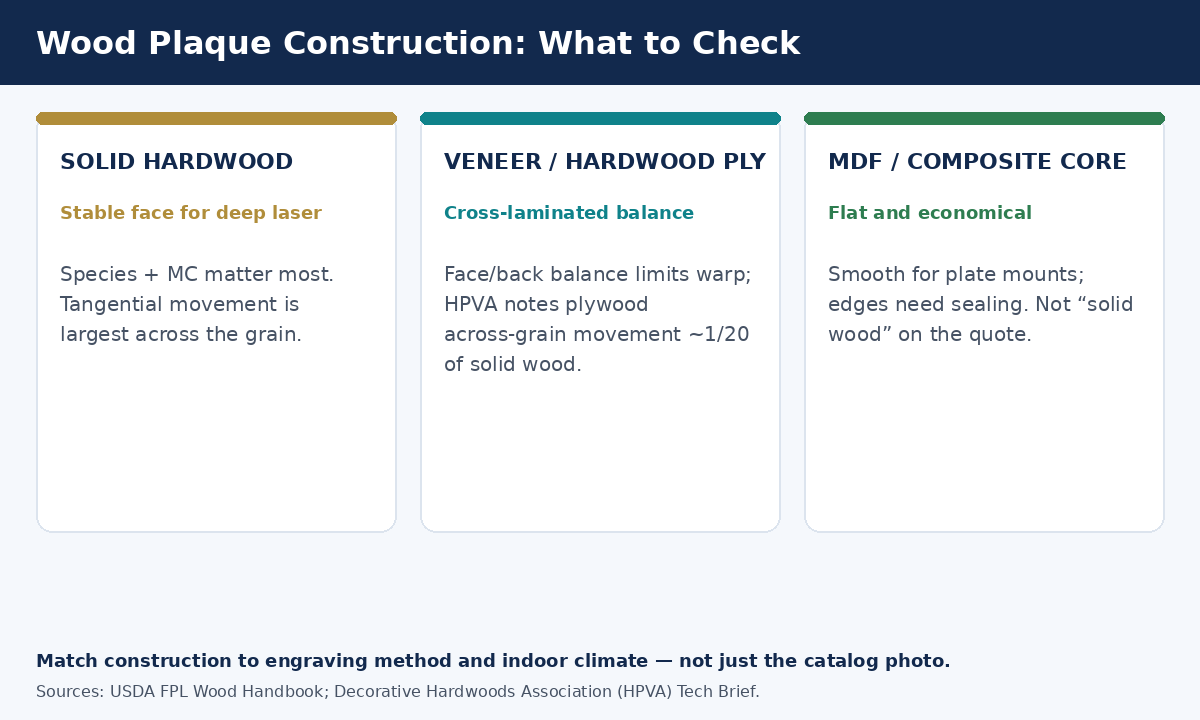
“Wood plaque” on a quote can mean solid hardwood, a veneered plywood panel or an MDF-core board. Those three move and engrave differently once indoor humidity changes.
Use solid hardwood when deep laser grain and weight matter; choose balanced veneered plywood when flatness across seasons matters; use sealed MDF-core blanks for plate-on-board value programs—and write the construction on the PO.
Why construction type beats a species marketing name
Trophy shops often compare “walnut,” “rosewood finish” or “oak” photos. The more useful first question is how the blank is built. Solid hardwood shows continuous grain and takes deep laser engraving well, but wood is anisotropic: the Decorative Hardwoods Association (formerly HPVA) technical brief notes that solid wood typically changes about 7–9% tangentially (across the grain) from green to the fiber saturation point, about 4–5% radially, and only 0.1–0.2% along the grain. That across-grain movement is what cups a wide plaque or lifts a glued plate after a dry winter in the shop.
Cross-laminated hardwood plywood restricts that tangential movement to roughly one-twentieth or less of solid wood by alternating grain directions in the plies, according to the same association brief. For a wall plaque that must stay flat under a metal plate or UV print, a balanced veneer face and back on a plywood or similar cross-banded core is often more forgiving than a thick solid board of the same face species. MDF or particleboard cores lay flat and machine cleanly for plate mounts and routed edges, but they are not solid wood—and unsealed edges can swell if humidity spikes in storage.
Match construction to how you decorate
- Deep CO₂ laser engraving into the face: solid hardwood or a thick, dense veneer face gives the grain contrast clients expect.
- Plate-on-board / rotary engraved plates: MDF-core or plywood blanks with a sealed face are usually enough; flatness and edge finish matter more than solid-wood weight.
- UV print or full-face laser photo work: a smooth, balanced panel with controlled moisture reduces banding and edge lift.
| Construction | Strength for shops | Main risk if unspecified |
|---|---|---|
| Solid hardwood | Grain depth, weight, premium feel | Cupping / seasonal size drift across the grain |
| Veneered hardwood plywood | Flatter seasonal behaviour | Face/back imbalance → warp; thin face sand-through |
| MDF / composite core | Flat, economical for plates | Edge swell; cannot be sold as “solid wood” |
Browse examples in our wooden plaque range, including the custom blank wood plaque award, and write “solid / veneered / MDF-core” on every request for quote—not only the colour name.
How Do Moisture Content and Finish Affect Laser Engraving Consistency?
Two plaques of the same species can engrave at different depths if one arrived wetter than the other. Moisture is a process variable, not a packaging footnote.
Target indoor-service moisture (often about 6–11% by region), acclimate blanks in your shop, keep face and back finishes balanced, and prove laser settings on a sample from the same lot.

Aim for the moisture your shop and clients actually live with
The USDA Forest Products Laboratory’s Wood Handbook Chapter 13 recommends installing interior woodwork, furniture and wood trim near the moisture content it will see in service—about 8% average (6–10% on individual pieces) for most of the United States, about 6% (4–9%) in the dry Southwest, and about 11% (8–13%) in damp coastal areas. Chapter 4 of the same handbook frames wood as hygroscopic: moisture content tracks the surrounding relative humidity and temperature until equilibrium moisture content (EMC) is reached. Protective coatings slow that exchange; they do not stop it.
For a trophy shop, that means a blank dried and packed in a humid coastal climate can still move after it sits in a heated Midwestern showroom—or after you laser a logo into a face that was wetter than the board you used to dial in power and speed. A 2024 Journal of Physics: Conference Series study on laser beam wood machining found that wood moisture affected ablation depth and the machined surface across oak, beech, pine, spruce, alder, ash and cherry on a CO₂ laser. You do not need their exact numbers to act: treat moisture as part of the engraving recipe.
Finish balance and shop acclimation
The Decorative Hardwoods brief warns that a highly impermeable finish on the face with an unfinished back can drive warp because the two faces exchange moisture at different rates. The same logic applies to plaque blanks: ask for comparable sealing on face and back unless you intentionally leave a raw face for laser work—and then seal after engraving. Acclimate opened cartons in the room where you engrave for at least a day or two before a large run, and spot-check a few boards with a pin or pinless meter if you stock dense hardwoods.
| Check | Why it matters for engraving |
|---|---|
| Lot MC near your shop EMC | Reduces depth drift between sample and bulk |
| Face/back finish balance | Limits cupping after laser heat and seasonal RH swings |
| Same species & sanding grit | Keeps burn colour and contrast predictable |
| Sample from the same shipment | Confirms the laser recipe on the wood you will sell |
Round and shaped blanks such as our custom round wood plaques for souvenirs still need the same moisture discipline—geometry does not cancel hygroscopic movement.
What Size Tolerance, Surface Flatness and Sample Checks Belong on Your PO?
A purchase order that only says “8×10 wood plaque” leaves every dispute about length, cup and edge profile open. Short, checkable limits close those disputes before production.
Write length/width/thickness tolerances, a warp/cup limit, edge profile, face grade, and require one engraved sample approved under your lighting and laser settings before bulk.

Put numbers and photos where species adjectives used to be
Wholesale plaque programs fail in quiet ways: a 0.5 mm thickness shift that throws off a fixture, a cupped face that will not vacuum-hold on the laser bed, or an edge radius that no longer matches your stock plate. The Forest Products Laboratory notes that dimensional change inside the normal 6–14% moisture band is approximately linear and can be estimated from species coefficients—so a blank that leaves the supplier at one moisture content and arrives at another will not keep the same width across the grain. You cannot stop that physics, but you can stop arguing about it after delivery.
A practical PO line set for trophy shops looks like this:
- Construction and species/face (e.g. solid black walnut; or walnut veneer, plywood core, balanced back).
- Target moisture content at packing (e.g. 6–9% for most inland U.S. heated shops) and a note that coatings retard but do not freeze MC.
- Dimensions: length × width × thickness with ± tolerances you can measure with a caliper.
- Flatness: maximum cup/twist over the face (a feeler-gauge or straight-edge check).
- Edge profile and corners: cove, bevel, radius—matched to your plates or fixtures.
- Face appearance: knot / sapwood / colour-band rules if clients expect a uniform wall of awards.
- Sample gate: one blank decorated with your process, photographed under your shop lights, kept as the reference.
Approve the sample the way your client will see it
We work with an MOQ of about 100 pieces per design and size on many award lines, and we offer samples before mass production. That sample is cheap insurance: engrave it on the same laser or rotary you will use, check plate fit, and keep the photos. Our multi-stage QC can include pre-shipment photos and videos so you can compare the bulk lot with the approved piece before it leaves. Desk pieces such as the custom solid wooden plaque desk nameplate need the same gate—small footprints still show thickness and angle errors under a client’s desk lamp.
| PO field | Example checkable language |
|---|---|
| Size | 203 × 254 × 19 mm ±0.5 mm (length/width), ±0.3 mm thickness |
| Flatness | Cup ≤0.5 mm across face when resting on a flat plate |
| MC | 6–9% at packing; report method (meter type) |
| Sample | One engraved sample approved; bulk must match photos |
If a lot misses the sample, stop the shipment conversation at photos—do not discover the mismatch at the awards banquet.
How Should You Balance MOQ, Mix, Lead Time and Packaging Damage Risk?
Unit price looks best on a single large SKU. Inventory risk and customs holds appear when mix, lead time and wood packaging are left vague.
Negotiate MOQ per size/design with clear mix rules, plan sample-then-bulk lead time (typically weeks, not days), and require ISPM 15-marked wood packaging plus unit protection against scuff and corner crush.
MOQ and mix are inventory decisions, not only price decisions
For many of our award items, MOQ sits around 100 pieces per design and size. That number protects unit cost, but a trophy shop rarely needs one hundred identical 9×12 boards and zero 7×9 boards in the same month. Ask whether mixed sizes can share a production slot, what the surcharge is for a second size, and whether leftover faces from a custom stain run can be restocked as blanks. With 23 years of export experience, the shops that stay solvent are the ones that treat MOQ as a forecast problem: bestsellers in depth, slow colours in shallow mix, and a written rule for what “assorted” means on the invoice.
Lead time is the second half of that trade-off. Handmade and finished plaque work commonly needs sample days first, then roughly one to several weeks for bulk depending on finishing and season—not a same-week factory flip. Build the event calendar backward from ship date, not from the day the PO is emailed.
Packaging protects both the plaque and the customs clock
Corner crush, face scuffs and loose parts in a carton are the damage modes shops photograph most often. Specify unit sleeves or film, corner protection, carton strength and how many pieces per inner box. Separately, if the supplier ships on wood pallets or in wood crates, those packaging materials entering or transiting the United States must meet ISPM 15: USDA APHIS requires debarked, treated wood packaging marked with the IPPC logo, country code, facility number and treatment code (such as HT or MB). U.S. Customs and Border Protection notes heat treatment must reach a minimum core temperature of 56°C for at least 30 continuous minutes. Noncompliant wood packaging can stop a shipment even when every plaque is perfect. That rule applies to the pallet, not to the decorative plaque itself—but you still need it on the booking checklist.
| Decision | Ask before you confirm |
|---|---|
| MOQ | Per size / per finish / mixed carton rules |
| Lead time | Sample days + bulk days; peak-season buffer |
| Unit pack | Sleeve, corner pads, pieces per inner |
| Wood packaging | ISPM 15 mark visible on pallet/crate |
| After-sales | Photo proof path for transit damage replacement |
We ship by express, air or sea with packaging options that include coloured, white, velvet and leather presentation boxes for finished awards, and we replace damaged pieces free with the next shipment after photo or video proof. For blanks, ask for the same photo discipline on arrival. Adjacent glass and crystal blanks in our glass awards and crystal trophies lines follow parallel sampling logic if you are building a mixed recognition wall.
Conclusion
Specify construction and moisture, approve an engraved sample, write tolerances and ISPM 15 packaging, then scale MOQ to what you can sell.
