Imported crystal looks clear in the catalog photo—until the first logo engraves cloudy, shallow, or off-center across a full carton.
Custom engraving on imported crystal awards works when you match three decisions before deposit: engraving method, blank geometry that method can mark, and artwork that is truly production-ready—then lock them with a proof and sample.

Below I separate laser from sandblast/sandcarve, spell out file formats that survive production, show how proofs and MOQ must travel together, and help you choose blanks versus pre-engraved pieces.
Which Engraving Method Fits Imported Crystal and Glass Blanks?
Shops often ask for “the best engraving.” On crystal and glass, best means the method that matches your artwork and the blank you are about to import.
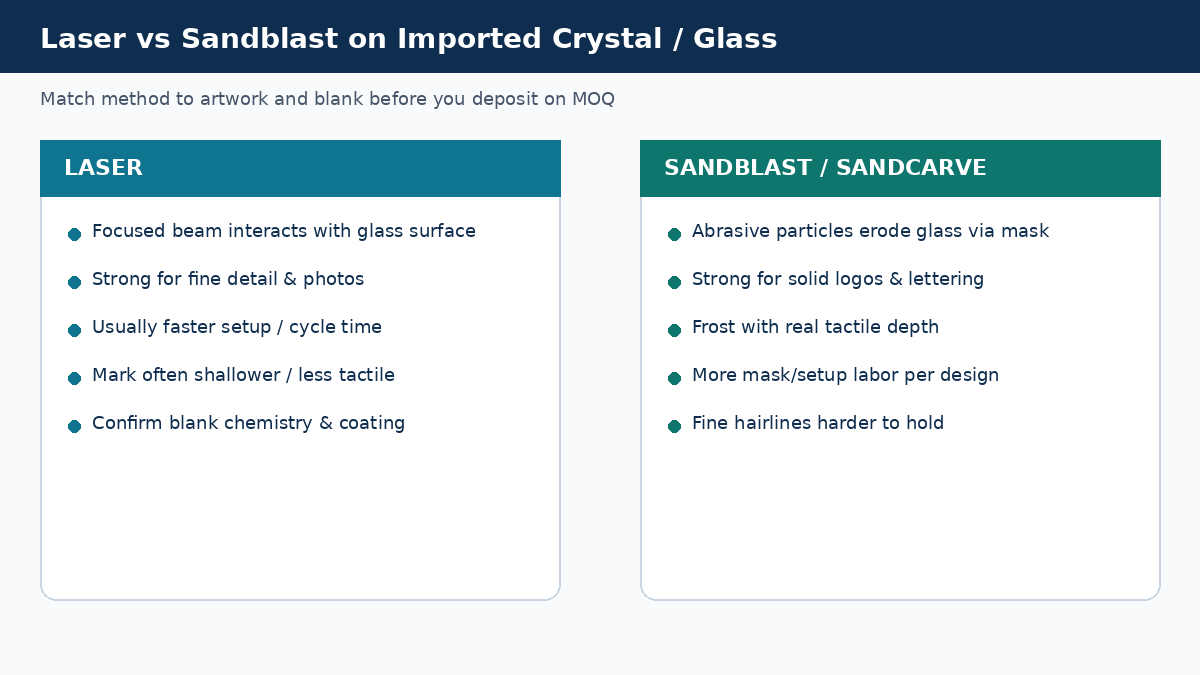
Choose sandblast/sandcarve when you need tactile frosted depth on solid logos and lettering; choose laser when you need speed and fine detail on glass that your laser can mark cleanly—and confirm the blank first.
What sandblasting actually does to glass
Sandblasting (also called sand etching or sandcarving in award shops) removes glass by mechanical erosion. A peer-reviewed glass micromachining study describes the mechanism clearly: a particle jet is directed at the workpiece so high-velocity abrasive particles erode material, with experimental jet speeds commonly in the 80–290 m/s range in lab setups (PMC / Micromachines). The same paper notes sandblasting is simple and low-cost for directional etching, yet it struggles with very small patterns because resist resolution and powder particle size limit fine features, and etched surfaces tend to be rough with tapered profiles.
For trophy work, that physics translates into a practical look: a frosted mark with real depth you can feel, excellent for seals, bold logos, and names—provided the artwork can be masked as solid shapes. Multi-level carving and paint-fill are shop techniques built on that depth, not on a marketing slogan.
What laser marking does on glass—and what it does not promise
CO₂ lasers can write directly on glass surfaces. An Optics Express study indexed by PubMed used ~10 µs pulses near 10.59 µm to generate surface structures on fused silica and Borofloat glass and showed that, with controlled pulse energy, those structures can be optically smooth and crack-free (PubMed abstract). That matters for importers because it proves glass is laser-addressable—but it is not a recipe that every award laser will frost a logo the same way. Trophy-shop lasers often produce a lighter, sometimes granular frost that favors photographs, fine lines, and fast one-offs. Some glass chemistries mark unevenly; some coated or back-painted blanks are designed specifically for laser.
I separate three questions before I recommend a method on an imported blank:
- Is the mark meant to feel deep (sandblast family) or read as fine surface detail (laser family)?
- Does the blank’s thickness, curve, and clear face leave a usable engraving window?
- Will the same method hold across the MOQ, not only on a hero sample?
Rotary engraving sits in a narrower lane
Rotary or mechanical engraving still appears on metal plates and some acrylics. On optical crystal blocks it is usually the wrong first tool: vibration and bit geometry fight brittle edges. If a quote mixes “engraving” without naming laser, sandblast, or subsurface laser, ask which machine will touch your blank.
| Method | Mechanism (simplified) | Best artwork | Typical tradeoff for importers |
|---|---|---|---|
| Sandblast / sandcarve | Abrasive erosion through a mask | Solid B/W vector logos & text | Depth and premium frost; more setup/mask labor |
| Surface laser | Localized laser–glass interaction | Fine detail, photos, fast text | Speed; often shallower mark; glass-dependent |
| Subsurface laser | Internal focus in optic crystal | 3D/internal images | Needs suitable optic blank; different file path |
| Rotary | Mechanical cutter | Metal plates more than crystal | Limited on brittle optical faces |
Do not order a tall optic tower for sandblast depth and a photo-heavy layout for the same SKU without testing. Method choice is a blank choice.
What Artwork Files Do Suppliers and Local Engravers Actually Need?
Most engraving rejects start as “almost ready” logos—screenshots, Word embeds, or flattened JPGs renamed as PDFs.
Send true vector files (AI, EPS, SVG, or vector PDF with fonts outlined) for logos and text; use high-resolution raster only when the process is photo/grayscale engraving—and never treat a web PNG as camera-ready.

Vector versus raster is a production rule, not a designer preference
NC State Extension explains the split plainly: vector formats such as SVG, EPS, and AI are built for scalable print work, while JPG, PNG, GIF, and TIFF are pixel grids better suited to photos and web use. A PDF may be either vector or raster depending on how it was made—so “I sent a PDF” is incomplete until someone zooms the art and confirms it stays sharp. The University of Tennessee at Chattanooga Library makerspace guide adds the same foundation for laser workflows: vectors keep clarity at any size because they store math (points, lines, curves), whereas rasters pixelate when enlarged.
For award engraving, that maps to shop floors I see across export orders:
- Logos, seals, monograms, and most name layouts → solid black-and-white vector. Convert fonts to outlines/curves. Avoid hairline strokes and tiny serifs that break when masked or lasered.
- Photographs or soft grayscale portraits → high-resolution raster at final size, only if the engraver’s process supports photo laser or a specialty grayscale path. Ask for their DPI minimum at final size instead of guessing.
- Office files and website downloads → not production art. Embedding a logo in PowerPoint does not create vectors.
A practical preflight checklist before you email art
- Open the file in a vector editor or ask the engraver to confirm paths (not a flat image XObject).
- Confirm color mode for etching: usually solid black for “frost this,” white/clear for “leave glass.”
- Outline fonts; include a PDF proof sheet with exact spelling, dates, and hierarchy.
- State the engraving face and maximum art height for the blank you are importing.
- Keep one locked master file; do not iterate on compressed WhatsApp screenshots.
Why importers feel this pain harder than local retail shops
When you buy blank glass trophies or blank crystal plaques by the carton, bad art multiplies. A local one-off can be remade in an afternoon; an import MOQ ships weeks later. Artwork is therefore part of landed cost control, not a creative afterthought. If your customer only has a PNG, budget redraw time before you freeze the PO—not after the vessel leaves port.
How Should Proofing, Samples, and MOQ Lock Together Before You Deposit?
A pretty digital mockup is not a production lock. Importers need a chain that connects art, blank, method, and quantity.
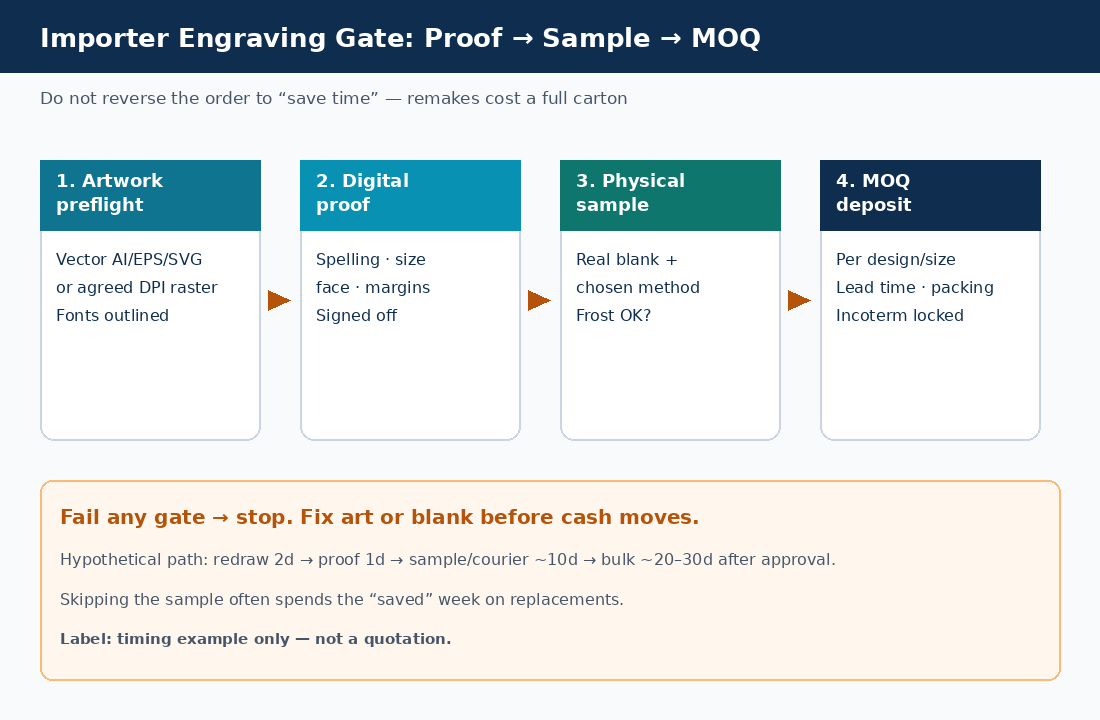
Approve a digital proof for layout, then a physical engraved sample on the real blank and method, then apply the per-design MOQ deposit—never reverse that order to “save time.”
The three locks
Lock 1 — Digital proof. Check spelling, logo proportions, margins from edges and bevels, and which face is engraved. For sandblast, confirm the maskable solids look bold enough. For laser photo work, confirm contrast.
Lock 2 — Physical sample on the production blank. Clarity, bubble/seed level, base fit, and the engraved frost all change with real glass. At GLORY AWARD & TROPHY we treat sample trial as a normal step before mass production, with multi-stage QC and pre-shipment photos/videos available for confirmation. Over 80% of our products are handmade with a typical production window of about 20–30 days after approval—so the sample is where calendar risk and quality risk meet.
Lock 3 — MOQ tied to the approved spec. Our crystal trophy MOQ is about 100 pieces per design and size. That number only protects you if it refers to the blank and engraving path you just approved. Changing thickness, base, or method after deposit is a new risk conversation.
A one-page importer worksheet
| Gate | Pass criteria | Fail action |
|---|---|---|
| Artwork preflight | Vector (or agreed DPI raster); fonts outlined | Redraw / request source files |
| Digital proof | Spelling, size, face, margins signed off | Revise art; do not cut masks yet |
| Sample on blank | Frost depth/contrast acceptable on real glass | Retune method or change blank |
| MOQ + terms | Per design/size, lead time, packing, Incoterm | Rewrite PI before deposit |
Hypothetical timing (not a quote)
Assume artwork redraw takes 2 business days, digital proof 1 day, sample production and courier 10 days, then bulk 20–30 days after approval. Skipping the sample to “hit a banquet date” often spends the saved week on replacements. I would rather show a customer one perfect sample than apologize for 100 shallow marks.
With 23 years of export experience serving overseas trophy shops, we expect engraving questions early. Send the blank model, method preference, and art together so the quotation can name the full path—not only a unit price.
Should You Import Blanks for Local Engraving or Order Pre-Engraved Pieces?
The import decision is really an ownership decision: who holds artwork risk, inventory flexibility, and last-mile personalization margin?
Import engravable blanks when personalization is your margin and you control a proven local method; order supplier engraving when you need matched depth across a corporate run and can approve proofs before bulk.

Path A — Blanks for local engraving
Blank jade glass awards for engraving, clear glass trophies, and crystal plaques let one MOQ support many end customers. You keep name-list flexibility and retail margin. The cost is process ownership: you must know whether your laser or sandblast cabinet likes that glass, and you must protect engraving faces in packing.
Browse our glass awards and crystal trophies with an engraver’s eye: Is the face flat enough? Is there a safe margin above the base? Will bevels clip the logo?
Path B — Supplier pre-engraving
Use this when a corporate or league order needs identical frost across dozens or hundreds of pieces, or when you lack sandblast capacity for deep logos. The supplier then needs the same vector discipline and sample approval you would demand in-house. Lead time includes art approval; rushing art is how bulk lots miss the banquet.
Path C — Hybrid
Stock blanks for everyday names; route deep-etch corporate seals to a controlled sample-then-bulk path. Hybrid fails when the blank SKU for retail and the blank SKU for corporate secretly differ in thickness or coating.
| Path | You own | You buy | Watch-outs |
|---|---|---|---|
| Local on blanks | Method + art + labor margin | Clear engraving window blanks | Test glass chemistry/coating |
| Supplier engraved | Customer briefing + proof sign-off | Method capability + QC photos | Art delays become ship delays |
| Hybrid | Segmentation rules | Two consistent blank families | Do not mix untested SKUs |
Closing the loop with the Insight
The importer’s real control point is not “laser or sandblast?” alone. It is the matched triple—method, blank, artwork—frozen by proof and sample before MOQ cash moves. That is how custom engraving works when crystal awards cross a border without turning into expensive scrap.
Conclusion
Match engraving method, blank geometry, and production artwork, then prove them on a sample before you deposit on the import MOQ.
