A lower China catalog price can vanish once freight, duty, fees, and unsellable pieces are added—or it can still beat a US distributor when your quantity is real.
Buying crystal awards direct from China is often cheaper per sellable piece when you can fill a per-design MOQ, wait through production and transit, and compare a full landed cost against a US distributor’s delivered invoice. A distributor often wins on mixed small lots, rush restocks, and first tests.

Below I separate the costs an FOB quote still leaves with you, work a clearly labeled hypothetical at a 100-piece MOQ, show when a US distributor still wins, and outline a fair side-by-side before either deposit.
What Costs Belong on a China Quote That a US Distributor Price Already Bundles?
Shops often subtract a China catalog price from a US list price and call the difference profit. Those two numbers rarely describe the same journey.
Add the costs an EXW or FOB quote still leaves with you—freight, insurance, classification-based duty, official entry fees, and brokerage—before you compare it with a US distributor’s delivered invoice.
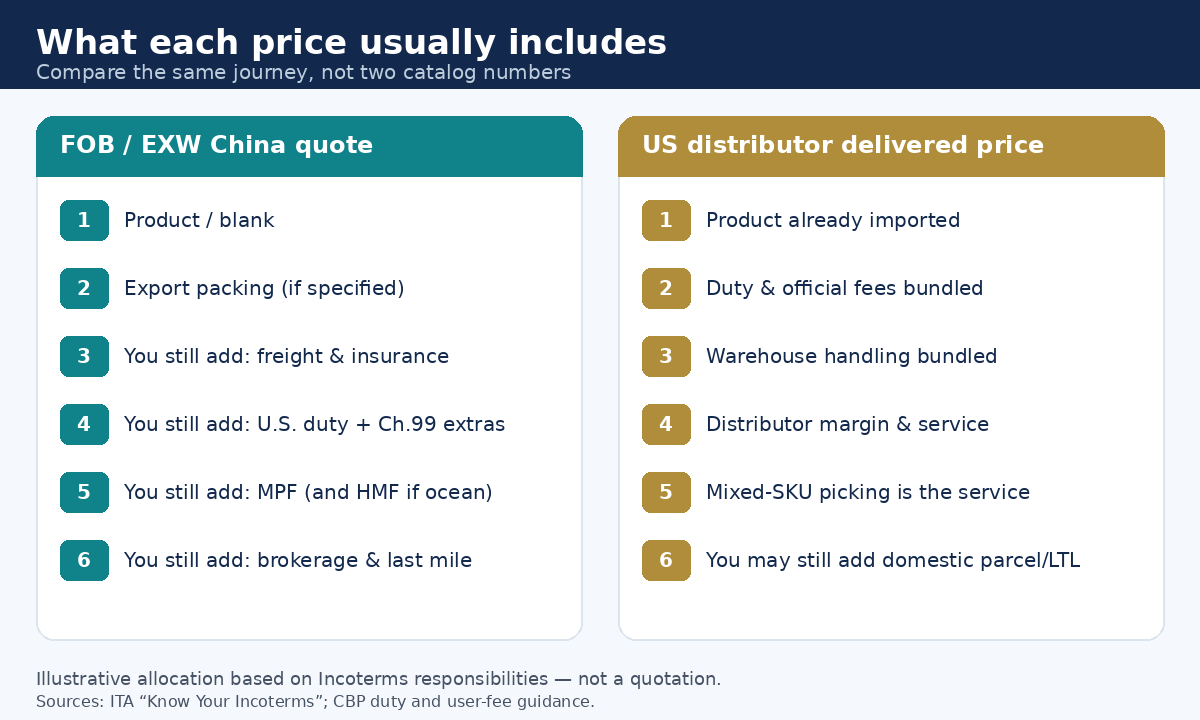
An FOB number and a distributor invoice are different products
The U.S. International Trade Administration describes Incoterms® 2020 as eleven ICC rules that assign who pays for and manages shipment, insurance, documentation, customs clearance, and related logistics. Each rule also says which party obtains import or export authorizations and bears those formalities. The same page is careful about what Incoterms do not cover: they do not list the contract price, set payment timing, or say when title passes.
That split is why a China “unit price” so often looks irresistible. A typical export quotation is EXW or FOB: you still own international freight, insurance, U.S. entry, duty, and the last mile. A U.S. distributor invoice is usually closer to goods sitting in a domestic warehouse, already entered, often with a small-lot pick and a short truck or parcel move to your shop. If I place those two numbers in one spreadsheet without naming the Incoterm, I am not comparing suppliers. I am comparing an unfinished journey with a finished one.
Duty is a classification question, not a rounding error
CBP explains that the Harmonized Tariff Schedule supplies duty rates, and that CBP—not the importer—makes the final determination of the correct rate. For a very specific item you may request a Binding Ruling.
I do not treat every crystal trophy as if one code were guaranteed. Many decorative glass awards can fall under heading 7013 (glassware for indoor decoration or similar purposes) in the USITC Chapter 70 schedule. In that chapter, subheading 7013.99.70 (cut or engraved, valued over $5 each) and 7013.99.90 (other than cut or engraved, valued over $5 each) each show a Column 1 general rate of 7.2 percent. Composite pieces, bent edge-worked glass, or metal-predominant trophies may classify elsewhere.
If those 8-digit subheadings do apply and the goods are products of China, the USITC China Tariffs reference list (last updated July 28, 2026) maps 7013.99.70 and 7013.99.90 to heading 9903.88.15. U.S. note 20(r) in Chapter 99 states that products of China covered by heading 9903.88.15 are subject to an additional 7.5 percent ad valorem duty, and that this additional duty applies together with the general rate on the underlying subheading. Other Chapter 99 notes or later revisions can add, suspend, or exclude measures, so a broker should read the current schedule before you treat 14.7 percent as “the” rate.
Fees that sit beside duty
CBP’s User Fee Table publishes the Merchandise Processing Fee for formal entries as a $34.58 minimum, 0.3464 percent ad valorem, and a $670.86 maximum (with a $4.15 manual surcharge). The same table lists the Harbor Maintenance Fee on imports at 0.125 percent ad valorem of the merchandise. CBP warns that published fees can lag official adjustments. HMF is a vessel-merchandise fee; an express or air shipment is a different path.
I add those lines whenever a China quote stops at the works or the port. A distributor’s delivered price already had someone pay a version of the same stack—then amortize it across many shops and many SKUs.
| Cost line | Usually visible on a China EXW/FOB quote? | Usually already inside a US distributor delivered price? |
|---|---|---|
| Product / blank | Yes | Yes, plus the distributor’s margin and service |
| Export packing | Often, if specified | Yes |
| International freight & insurance | No, unless CIF/CIP/DDP | Yes |
| U.S. duty and Chapter 99 additional duties | No, unless DDP | Usually absorbed into the sell price |
| MPF and, if applicable, HMF | No, unless DDP | Usually absorbed |
| Customs brokerage / entry | No, unless DDP | Usually absorbed |
| Domestic delivery to your shop | Only if the term says so | Often a parcel/LTL add-on you can quote |
| Small-lot picking of mixed SKUs | Rare at a design-level MOQ | Yes, that is much of the service |
Door-to-door or DDP terms from an overseas supplier can close part of this gap. They still are not identical to a domestic restock if payment timing, MOQ, and replacement speed differ.
How Do You Compare Landed Cost per Sellable Piece at Your Real Quantity?
Even a complete cost stack misleads if you divide it by a catalog quantity you will not actually buy or cannot actually sell.
Build one landed-cost worksheet, apply official duty and fee rules plus your freight assumptions, then divide by sellable pieces at the quantity you will order—not the quantity that makes the unit price look best.

Build one worksheet, then divide by the pieces you can sell
I use the same skeleton on every comparison: merchandise value + freight + insurance + duty + official fees + brokerage + domestic tail + a reserve for pieces you cannot sell. Then I divide by sellable pieces at the quantity I will actually order—not the quantity that makes the unit price look best in a catalog.
Official inputs can be pinned down. Under the illustrative path above, a customs value of $800 would face $117.60 of combined 7.2 percent plus 7.5 percent duty if 7013.99.70 or 7013.99.90 and heading 9903.88.15 both apply. CBP’s formal-entry MPF on that same $800 is not 0.3464 percent of $800 ($2.77). It is the published $34.58 minimum, because $2.77 sits under the floor. The ad valorem MPF only exceeds $34.58 once customs value reaches about $9,983 ($34.58 ÷ 0.003464). Most first trophy-shop crystal orders never reach that value, so the MPF minimum behaves like a fixed setup cost. That is one reason a 100-piece trial and a 400-piece restock do not scale the same way.
A labeled hypothetical—not a quotation
Assume, for illustration only: you compare one ready-made crystal award at a hypothetical FOB value of $8.00 each for 100 pieces (our usual crystal-trophy MOQ is about 100 pieces per design and size). Merchandise value is $800. You ship by express, so I omit HMF. I assume $250 express freight, $125 brokerage, and $15 cargo insurance. Duty at the illustrative 14.7 percent is $117.60. MPF is $34.58. Landed total = $1,342.18, or $13.42 each. If I reserve two pieces as unsellable (a 2 percent caution, not a measured breakage rate), cost per sellable piece is $13.70. Against an assumed U.S. distributor delivered price of $18.00 for the same SKU, the import path saves about $4.58 each—before you count staff time.
Now change only the demand: you needed 25 pieces of that design this season. The import path still commits about $1,342, while 25 distributor pieces cost $450. The “cheaper China price” becomes the more expensive inventory decision.
None of the assumed freight, broker, insurance, or distributor figures is a live quote, a GLORY price, or an industry average. Re-run the sheet with your numbers. At GLORY AWARD & TROPHY we can quote crystal trophies and glass awards with the Incoterm named, so you can drop the merchandise line into this worksheet instead of guessing.
| Worksheet line (hypothetical 100 pcs) | Amount | Notes |
|---|---|---|
| Merchandise (100 × $8.00 FOB) | $800.00 | Assumed value, not a quote |
| Express freight | $250.00 | Assumed |
| Cargo insurance | $15.00 | Assumed |
| Illustrative duty at 14.7% | $117.60 | 7.2% + 7.5% on $800, if that path applies |
| Formal-entry MPF | $34.58 | Published minimum, because 0.3464% × $800 = $2.77 |
| Brokerage | $125.00 | Assumed |
| Harbor Maintenance Fee | $0.00 | Omitted for an express assumption |
| Landed total | $1,342.18 | $13.42 each; $13.70 if 98 pieces are treated as sellable |
| Assumed distributor delivered | $1,800.00 | $18.00 × 100, assumed |
Quantity is the hidden switch
Fixed lines (MPF minimum, brokerage, sample freight) shrink per piece as quantity rises. Variable lines (duty, often freight) stay proportional. Handmade production—over 80 percent of our products, with a typical 20–30 day bulk window after approval—does not change the arithmetic, but it does change when cash comes back. I would rather show a shop a complete sheet at 100, 200, and “only 25” than argue about a single catalog gap.
When Does a US Distributor Still Win Despite a Lower China Unit Price?
A cheaper landed unit cost is useless if the order cannot match how a trophy shop actually sells: mixed SKUs, short calendars, and first tests.
A US distributor still wins when you need mixed quantities below a China design MOQ, when the event sits inside production plus transit, or when you do not want to be the importer of record on this shipment.
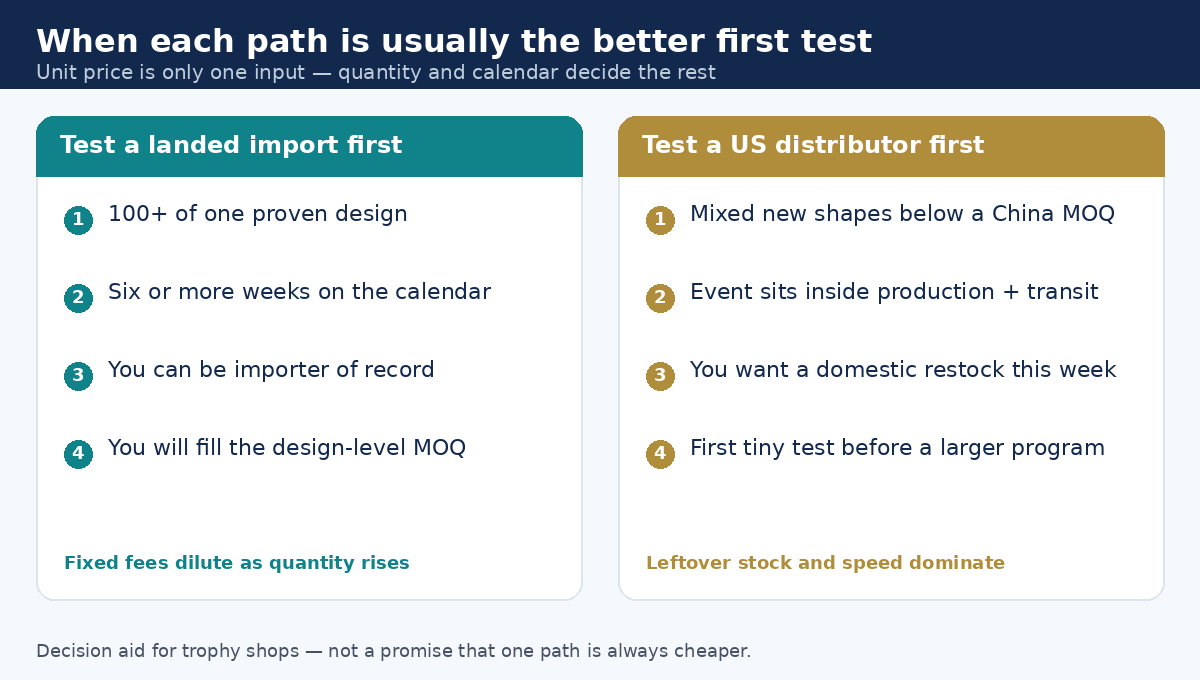
The distributor is selling time, mix, and a smaller first bet
A lower landed unit cost is not useful if the order cannot match how a trophy shop actually sells. Our crystal trophy MOQ is about 100 pieces per design and size, and we keep more than 1,000 ready-made designs available for wholesale selection. That combination helps a shop that already knows its next corporate or sports runners. It is a poor fit for a shop that needs twelve different shapes, fifteen of each, next Thursday.
I treat a U.S. distributor as the better buy—sometimes even at a higher unit price—when at least one of these is true:
- The live demand is a mixed assortment below a per-design import MOQ.
- The ceremony date sits inside production plus transit, not after it.
- The shop does not want to act as importer of record on this shipment.
- The value of a fast replacement or a local restock exceeds the catalog gap.
Lead time makes this concrete. Sample trial is available before mass production; samples often move faster than bulk. Bulk production still commonly needs about 20–30 days after approval because over 80 percent of the line is handmade, and then the goods still have to travel. We can ship by express, air, sea, or rail, including door-to-door service and an insurance option, but physics and customs do not collapse to a two-day domestic warehouse pick. If an awards banquet is three weeks away and the design is not already on the water, paying a distributor premium can be the cheaper way to keep the account.
Buying from a U.S. warehouse does not erase origin costs
Shops sometimes hope a domestic PO will dodge China-origin duty entirely. Often it does not. The distributor, or the importer behind that distributor, may already have paid classification-based duty and fees and then recovered them in the sell price. When additional duties change, those changes tend to show up later as domestic price adjustments rather than as a line you never feel. Direct import makes the duty visible; it does not uniquely create it.
The honest comparison is who can move your quantity more efficiently. A distributor consolidates many shops into container-level economies and then resells mixed cartons. You pay for that service. Direct import lets you keep the consolidation margin—if you can fill the carton with demand you believe in.
A hybrid is a strategy, not indecision
Many shops I advise on paper do both. They import the proven runners—star awards, iceberg shapes, blank plaques they engrave locally—at design-level quantities, and they buy odd sizes or emergency toppers from a domestic distributor. Consistency still matters: two suppliers’ “same” star will not match in weight or tint if a client photographs them together. Pick one source for any single program that must match.
We replace damaged or defective pieces free of charge with the next shipment after photo or video proof. That policy is useful for ongoing wholesale relationships; it is not the same as a local counter swap the night before an event. Budget the difference when the calendar is tight.
| Situation | Path I would test first | Why |
|---|---|---|
| 100+ of one proven design, six+ weeks available | Direct import with a full landed sheet | Fixed fees dilute; catalog gap can survive duty and freight |
| 15–40 pieces across several new shapes | US distributor (or a tiny test, then import later) | MOQ leftover risk dominates unit price |
| Banquet inside production + transit | Distributor or in-stock domestic | A cheap trophy that arrives late is not cheap |
| Repeat program that must match last year’s lot | Same source as the original batch | Visual matching beats a small saving |
| First order with a new overseas supplier | Sample, then a tight landed comparison | You are also buying process confidence |
How Should You Run a Fair Side-by-Side Before You Place Either Order?
Bad comparisons start as mismatched paperwork: different boxes, different Incoterms, or a duty rate copied from the wrong article.
Lock the same SKU, packing, quantity, and delivery point on both quotes, confirm classification with current official sources or a broker, approve a sample, then choose import, distributor, or a hybrid against your calendar.
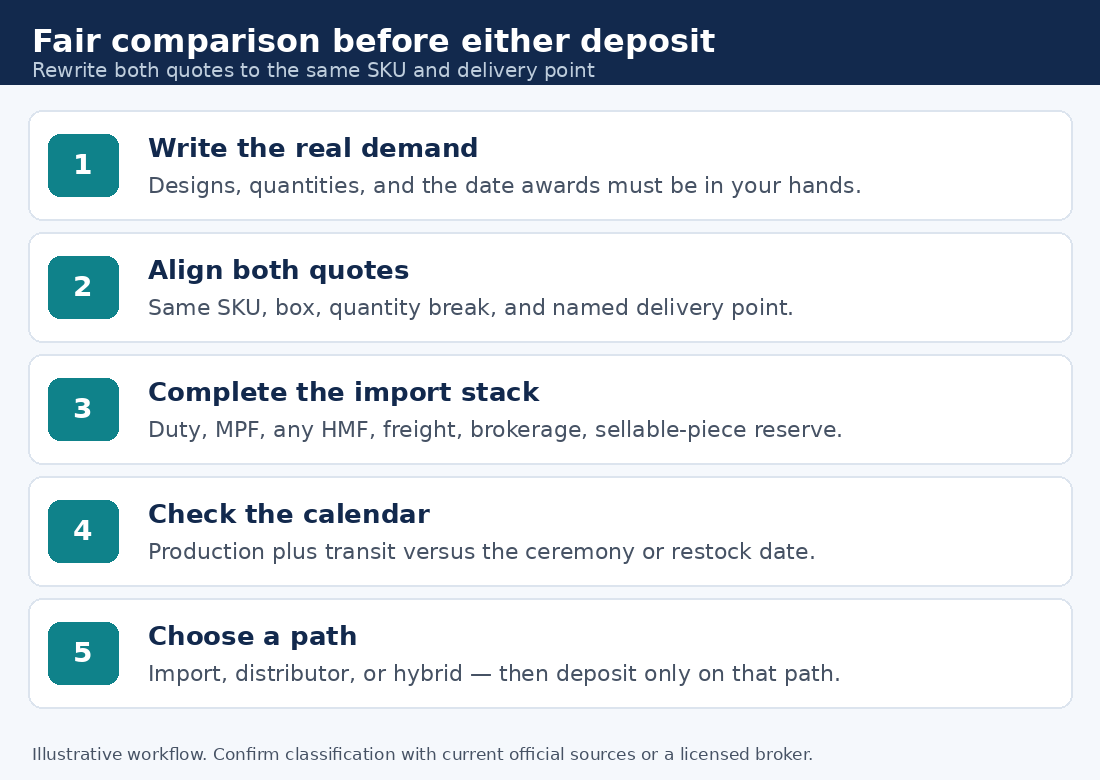
Make the two quotes describe the same object
Before I decide “China is cheaper,” I lock eight fields on both documents: item (shape, size, material, base), decoration method, gift box, quantity break, Incoterm and named place, freight mode, who files the U.S. entry, and what happens if pieces arrive chipped. If one quote is FOB a Chinese port and the other is delivered to your shop, I rewrite both to the shop door—or both to the first U.S. warehouse—before subtracting.
CBP reminds importers that the duty rate they research is only as good as the information they provide, and that CBP makes the final determination. Ask your broker for an entry estimate on the actual article, or request a Binding Ruling when the classification is material to the decision. Do not copy a blog’s illustrative 14.7 percent onto a metal cup or a wood plaque.
Use a sample as a price control, not a courtesy
At GLORY AWARD & TROPHY, sample trial is a normal step before mass production. I want the sample for clarity, weight, engraving window, and packing—and I want its cost and courier fee sitting on the same worksheet as the bulk landed cost. A shop that skips the sample to “save a week” often spends that week later arguing about a carton of rejects. Pre-shipment photos and videos can confirm a bulk lot against the approved sample; they do not replace the first physical piece.
Look at the actual SKU you will price. A star crystal trophy and a colorful crystal iceberg award do not share weight, packing cube, or engraving area, so they do not share freight or breakage behavior. Mixing them into one “average trophy” number is how landed-cost sheets go wrong.
A short decision sequence
- Write the client demand: which designs, how many, which date.
- Get a China quote that names Incoterm, packing, and production window after sample approval.
- Get a distributor quote for the same designs and boxes, delivered.
- Add duty, MPF, any HMF, freight, brokerage, and a sellable-piece reserve to the import side.
- Compare totals at the quantity you will order, and at the quantity you might only sell this season.
- Choose import, distributor, or hybrid; then place the deposit only on the path you selected.
With 23 years of export experience serving overseas trophy shops, I would rather send a complete line-item quotation you can drop into this sequence than win an argument about a headline unit price. If you want that sheet built around a specific model, contact us with the SKU, quantity, destination city, and the date the awards must be in your hands.
| Check | Import quote | Distributor quote | Pass? |
|---|---|---|---|
| Same SKU, size, and base | Named | Named | |
| Same box / inner pack | Named | Named | |
| Same quantity break | Stated | Stated | |
| Delivery point aligned | Incoterm + place | Door or warehouse | |
| Duty and fees treated | Line item or DDP | Bundled, acknowledged | |
| Calendar vs production + transit | Dates written | Stock or lead time written | |
| Sample / photo path | Agreed | Agreed if needed | |
| Damage remedy | Stated in writing | Stated in writing |
Conclusion
Compare landed cost per sellable piece at your real quantity and calendar—not the China catalog price against a US list.
