Award weekend does not move—even when artwork, handmade crystal production and ocean cutoffs all slip in the same month.
Reverse-schedule from the ceremony: lock artwork first, plan about 20–30 days of handmade production, then add mode-specific transit, customs gates and a local engraving/breakage buffer—not a factory week count alone.

Below I break the calendar into reverse planning, what must be locked before production, how ocean/air and ISF gates change landed timing, and how to buffer peak-season name lists.
How Do You Reverse-Schedule Crystal Award Orders from the Ceremony Date?
A production week on a quote feels reassuring until the banquet is already on the venue calendar.
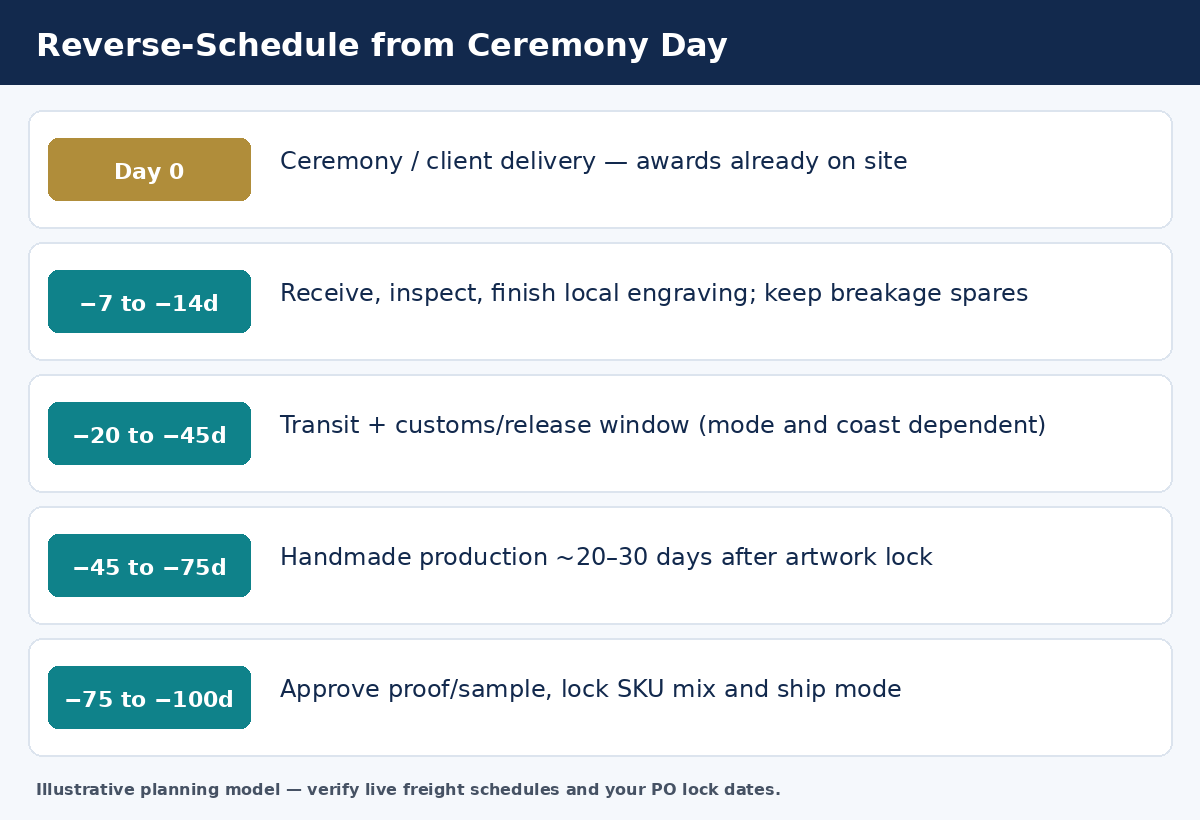
Work backward from the in-hands date: local buffer, transit/release, 20–30 days production after artwork lock, then proof/sample time—stacked, not guessed.
Start from the date you cannot miss
Trophy shops usually hear “lead time” as a factory number. The ceremony date—or your retail client’s pickup date—is the number that actually matters. Work backward:
- On-site buffer (about 1–2 weeks): receive, inspect, complete any local engraving, and keep a few spare pieces for transit damage.
- Transit and release window: ocean versus air changes this block more than most buyers expect.
- Production after artwork lock (about 20–30 days for handmade crystal): the clock starts when the design, size, and decoration method are frozen—not when the first email arrives.
- Proof and sample lock: name lists, logo files, and sample approval often consume more calendar than production itself.
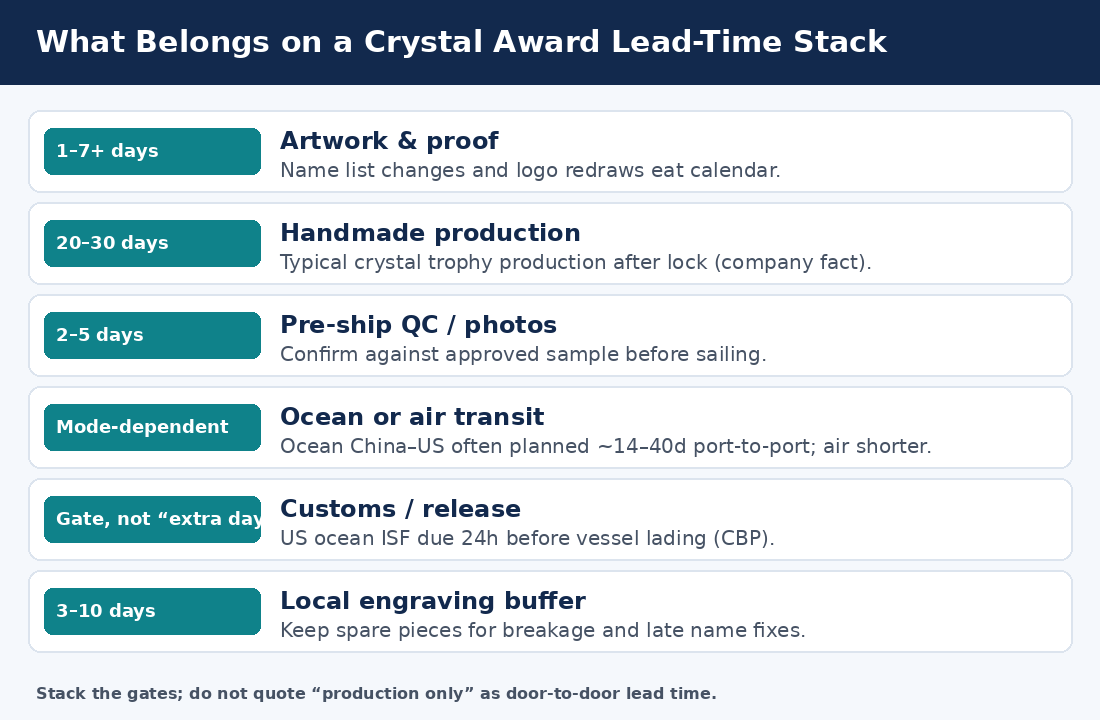
A planning stack, not a single quote line
| Calendar block | Typical planning range | What usually goes wrong |
|---|---|---|
| Artwork / engraving proof | 1–7+ days | Late name changes restart proofs |
| Handmade production after lock | ~20–30 days | Treating “inquiry day” as day zero |
| Pre-shipment photos / QC | 2–5 days | Skipping sample match under real light |
| Ocean or air transit | Mode-dependent | Quoting port-to-port as door-to-door |
| Customs / security filing gates | Must clear before/at arrival | Missing ocean ISF timing for U.S. imports |
| Local finishing buffer | 3–10 days | No spare units for breakage |
After 23 years exporting crystal and glass awards, we still see the same pattern: shops that only negotiate a production week number still miss peak weekends because transit, proofs, and local finishing were never on the same calendar. Browse ready designs in our crystal trophies and glass awards ranges while you lock the schedule, not after the banquet date is fixed.
What Must Be Locked Before the 20–30 Day Production Clock Starts?
Handmade crystal time only helps if the clock starts on a frozen file—not on a moving logo.
Lock size, decoration method, logo/name proof and sample criteria before production day one; late artwork changes restart calendar, they do not “expedite” it.
Production does not start on the first quote email
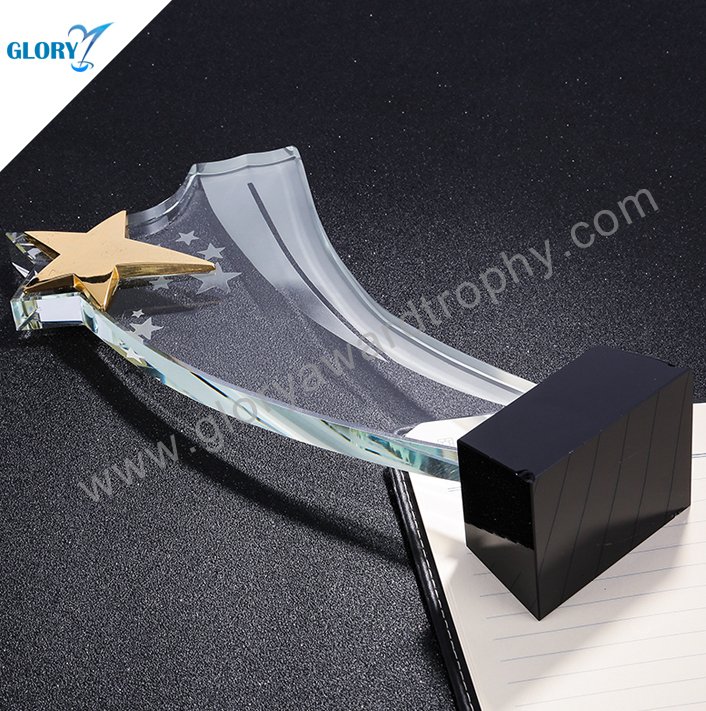
For handmade crystal awards, a useful planning assumption is about 20–30 days of production after the artwork is locked. That lock usually includes:
- Final SKU / size / base options
- Logo file in the required format
- Engraving method (surface laser, sandblast, UV print, inner laser, etc.)
- Name list or a clear rule for when names can still change
- An approved sample or digital proof you will use for pre-shipment checks
If any of those move after cutting starts, you are not “expediting”—you are restarting part of the clock.
Why samples and proofs protect the calendar
A sample trial before mass production is not only a quality ritual. It is a schedule tool. Once you approve a physical or tightly specified digital sample, pre-shipment photos and videos can be checked against that reference instead of a vague memory of “clearer crystal.” Multi-stage QC and pre-shipment confirmation only save time when both sides share the same picture of “accepted.”
| Lock item | Why it belongs before day 1 of production | Late-change cost |
|---|---|---|
| Size and blank family | Cutting and polishing paths differ by blank | Remake risk |
| Decoration method | Tooling and fixtures change | Queue reset |
| Logo / text proof | Spelling errors become scrap | Remake + delay |
| Name-list cutoff | Individual plates/blocks cannot wait forever | Partial shipment or air upgrade |
| Carton / gift-box choice | Pack materials and drop tests differ | Repack delay |
MOQ for crystal trophies is commonly about 100 pieces per design and size. That does not mean you must engrave every name overseas. Many shops import blanks or partially finished lots, then finish names locally for late HR lists—trading a little unit handling for a lot of calendar safety.
How Do Ocean, Air and Customs Gates Change Landed Lead Time?
The same finished carton can be weeks apart on the calendar depending on ocean versus air—and whether import filings were ready before lading.
Treat ship mode and U.S. ocean ISF timing as part of lead time; CBP expects the ISF-10 24 hours before vessel lading, so broker data belongs on the critical path.

Mode choice is a lead-time decision
Transit is not a footnote under “shipping.” For China-origin awards into the United States, freight planners commonly use ocean port-to-port brackets on the order of about two to six weeks depending on origin, destination coast and service, with door-to-door ocean windows that can stretch further once inland moves are included. Air is typically measured in days rather than weeks. Those ranges are planning brackets from logistics lane data—not a promise for your container—so verify the live schedule when you book.
What matters for a trophy shop is the decision rule:
- Ocean when the ceremony is far enough that landed cost matters more than speed.
- Air / express when a late name list or a remake would otherwise miss the event and the margin still works.
- Split shipments when bestsellers can sail early as blanks and only rush pieces fly.
Customs gates are calendar gates
For U.S.-bound ocean cargo, the Importer Security Filing is not paperwork you file after the ship arrives. CBP’s ISF guidance states that the ISF-10 is due 24 hours prior to vessel lading, and CBP measures timeliness against vessel departure timing (CBP ISF FAQ, May 2023; see also the 2018 ISF FAQ timing section and CBP’s 10+2 presentation). If your broker lacks manufacturer, HTS, and stuffing details early, the “shipping” block slips even when production finished on time.
| Gate | Why trophy shops feel it | Practical move |
|---|---|---|
| Artwork lock | Starts the 20–30 day production clock | Freeze files before deposit clears cutting |
| Vessel cutoff / ISF | Ocean data due before lading | Send commercial details to the broker early |
| Mode choice | Weeks vs days of transit | Decide with the ceremony date in writing |
| Release / exam risk | Holds add uncertainty after arrival | Clean invoices and consistent descriptions |
| Last-mile + engraving | Local work still needs calendar | Keep blank spares and a name-list cutoff |
We ship by express, sea freight and railway, including door-to-door options with insurance when needed. Ask for the mode on the same message as the ceremony date so the quote is a landed schedule, not only a factory week count.
How Should Trophy Shops Buffer Peak Season and Late Name Lists?
Peak season fails when final recipient names arrive after the ocean cutoff you needed last month.
Pre-stock blanks, split shape orders from name orders, set client cutoffs, and keep breakage spares—so HR delays do not become missed ceremonies.
Peak season is a name-list problem as much as a factory problem
Corporate year-end recognition, sports finals and school ceremonies cluster. End clients often finalize categories and recipient names late—sometimes only weeks before a December banquet—while handmade crystal still needs proofing and production time. If you wait for the final PDF of names before you place any purchase order, you inherit their scramble.
Buffers that usually pay for themselves
- Pre-stock blanks for your top corporate and sports shapes before the busy quarter.
- Separate “shape PO” from “name PO” so glass can be made while HR finishes spelling.
- Keep a breakage/remake allowance (pieces or an agreed remake path). Damaged pieces can be replaced on a later shipment after photo/video proof, but the ceremony cannot wait for the next ocean sailing.
- Publish an internal cutoff to your retail clients: after date X, names are local-engrave only or air-freight surcharge.
- Use supplier media after order confirmation to pre-sell designs while stock is in transit—so sales continue without promising impossible production weeks.
| Season strategy | Best when | Watch-out |
|---|---|---|
| Import blanks early | Repeat shapes, local engraving capacity | Inventory cash tied up |
| Full overseas engraving | Stable name lists, early PO | Late spelling changes |
| Hybrid (blank ocean + rush air) | Mixed certainty across SKUs | Two freight files to track |
| Distributor top-up | Tiny emergency quantities | Higher unit cost |
Put the schedule on the purchase order
Write the ceremony or in-hands date, artwork lock date, production window, ship mode, and broker contact on the PO. A lead time that exists only in chat will lose to whoever changed the logo last. If you need a working calendar for a specific SKU mix, send the event date, destination port or airport, and whether names are final when you request a quote.
Conclusion
Lock artwork, stack 20–30 day production with transit and customs gates, then keep local buffers for names and breakage.
