A glass award blank that chips at the bevel or cracks under your laser still costs a remake—and it can fail the week of the banquet.
Treat wholesale glass award blanks as an operations choice: match the substrate to your in-house engraving method, write checkable size, edge and stress specs, and approve an engraved sample from the same lot before you lock the order.

Below I separate what “blank” really means, when stocking beats pre-engraved imports, which checks belong on the purchase order, and how laser or sandblast work changes what you should buy.
What Does a “Glass Award Blank” Actually Mean for a Wholesale Buyer?
Catalogs use “blank” as if it were just an unengraved SKU. For a trophy shop, it is a decision about who personalizes the piece and when that work happens.
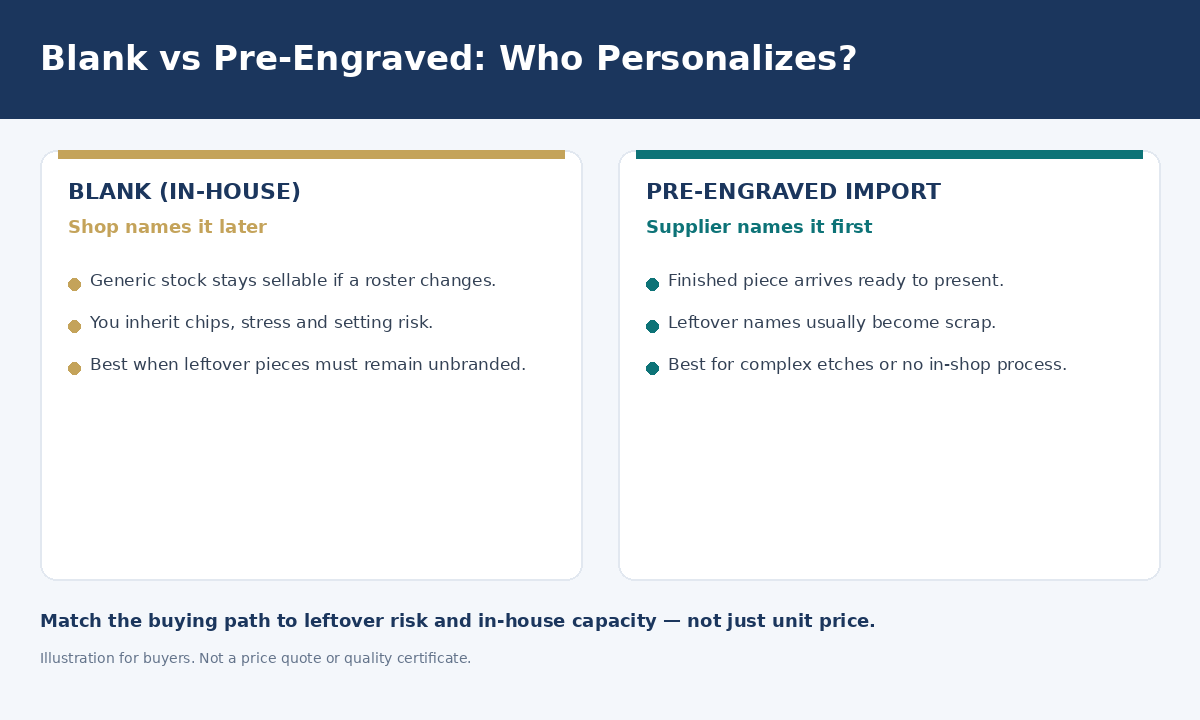
A blank is an unfinished award you will decorate in-house. That shifts inventory risk toward generic stock you can name later, and it shifts process risk—chips, stress and engraving consistency—onto your shop.
Blank means unfinished—not “cheaper crystal”
When a trophy shop searches “glass award blanks,” the useful meaning is operational: the piece leaves the supplier without the recipient’s name, logo or event title, so your shop can decorate it after the order is sold. That is different from a finished, ready-to-present award, and it is also different from asking an overseas supplier to engrave the run before shipment. Those two paths change who owns last-minute spelling changes, who holds generic inventory, and who absorbs a cracked piece during decoration.
I do not treat “blank” as a material grade. Jade glass, clear soda-lime glass and higher-clarity optical or K9 pieces can all be sold as blanks. Material labels deserve their own comparison; here the first question is whether you are buying a decorate-it-yourself stock item.
Why glass makes that choice physical, not just commercial
The National Glass Association’s technical paper on typical soda-lime float glass states that glass is a brittle material: it behaves elastically until it fractures, and the breaking load varies with the distribution, orientation and severity of inhomogeneities and micro-flaws in the surface. Award blanks are not window lites, but the same fracture logic applies at bevels, bases and logo faces—the places your rotary fixture, laser bed or blast stencil will clamp or decorate.
A second hidden variable is residual stress from cooling. A Bureau of Standards study on annealing (now part of NIST) explains that the purpose of annealing is to avoid or remove stresses that might remain permanent and injurious in use. Those residual stresses show up as variations in refractive index (double refraction) and as a greater tendency of the glass to warp or break. If cooling is not controlled, permanent stresses can be reintroduced while the glass hardens, or temporary stresses can break it after it has hardened. A pretty catalog photo cannot show that. A polarized-light check and a same-lot engraved sample can.
Browse current examples in our glass awards range, including blank glass trophies and blank crystal plaque awards, and ask the quote to state “blank / unengraved” plus the substrate family—not only a model number.
| What the quote says | What you should confirm |
|---|---|
| Blank / unengraved | No name, logo or event text applied |
| Jade / clear glass | Soda-lime family versus an optical or crystal label |
| Ready for engraving | Face, bevel and thickness suit your process |
| Handmade look | Edge polish and residual stress still need a sample |
When Does Stocking Blanks Beat Ordering Pre-Engraved Awards?
Unit price on a named, imported award can look tidy. Leftover names after a cancelled banquet do not go back on the shelf.
Stock blanks when you need last-minute names and leftover pieces must remain sellable. Order pre-engraved work when the design is complex, your shop cannot decorate it, or the whole run is already named.

Leftover value is the variable most quotes hide
I separate three clocks that buyers often mash together: production lead time, decoration time, and how long leftover stock stays sellable. A pre-engraved import can look cheaper per finished piece if you count only unit price. It becomes expensive if a school cuts the roster, a sponsor changes a logo, or thirty named awards sit in a box that no other client will take.
With 23 years of export experience, I still see shops over-index on the first invoice line and under-count leftover names. Our typical MOQ is about 100 pieces per design and size. That number is easier to live with when the 100 pieces are generic blanks you can assign later than when they are already titled for one Friday-night banquet.
A worked example—not a price list
The following numbers are an assumption for illustration, not a market survey or a quotation.
Suppose you need flexibility around 70 confirmed awards and you must order 100 pieces of one design and size. Path A: blanks at a hypothetical $8 each, plus $3 of in-shop labor and consumables for each piece you actually engrave. You spend $800 on 100 blanks and $210 to decorate 70, or $1,010 delivered, and you still hold 30 undecorated blanks with a leftover inventory value of $240 that you can sell later. Path B: comparable pre-engraved imports at a hypothetical $13 each, or $1,300 for 100 named pieces. If 30 names are unused, that leftover $390 is scrap.
Under those assumptions, Path A costs about $14.43 per award delivered today and keeps reusable stock; Path B costs about $18.57 per delivered award and leaves nothing reusable. Change the unused quantity, labor rate or unit prices and the ranking can flip—which is the point. Run the arithmetic on your own numbers before you choose.
When pre-engraved still wins
- The shape is awkward to fixture on your laser or in a blast cabinet.
- The decoration is a deep three-dimensional etch or a layout your shop cannot repeat consistently.
- The entire run is already named and will ship straight to the event.
- You have no safe, controlled sandblast or laser capacity.
We can supply samples before mass production and more than 1,000 ready-made designs, so you can test a blank on your equipment first. If you later want a run engraved before shipment instead, say so on the inquiry—do not discover the path after the carton lands. Adjacent crystal trophies follow the same leftover-value logic when you mix materials on a recognition wall.
| Situation | Lean toward blanks | Lean toward pre-engraved |
|---|---|---|
| Last-minute name list | Yes | Risky |
| Leftovers must resell | Yes | Named leftovers are scrap |
| Complex 3D decoration | Only if you can repeat it | Usually better |
| No in-house process | No | Yes |
What Specs and Sample Checks Belong on a Wholesale Blanks Purchase Order?
A purchase order that only says “jade glass award, 8 inch” leaves every dispute about thickness, chips and residual stress open.
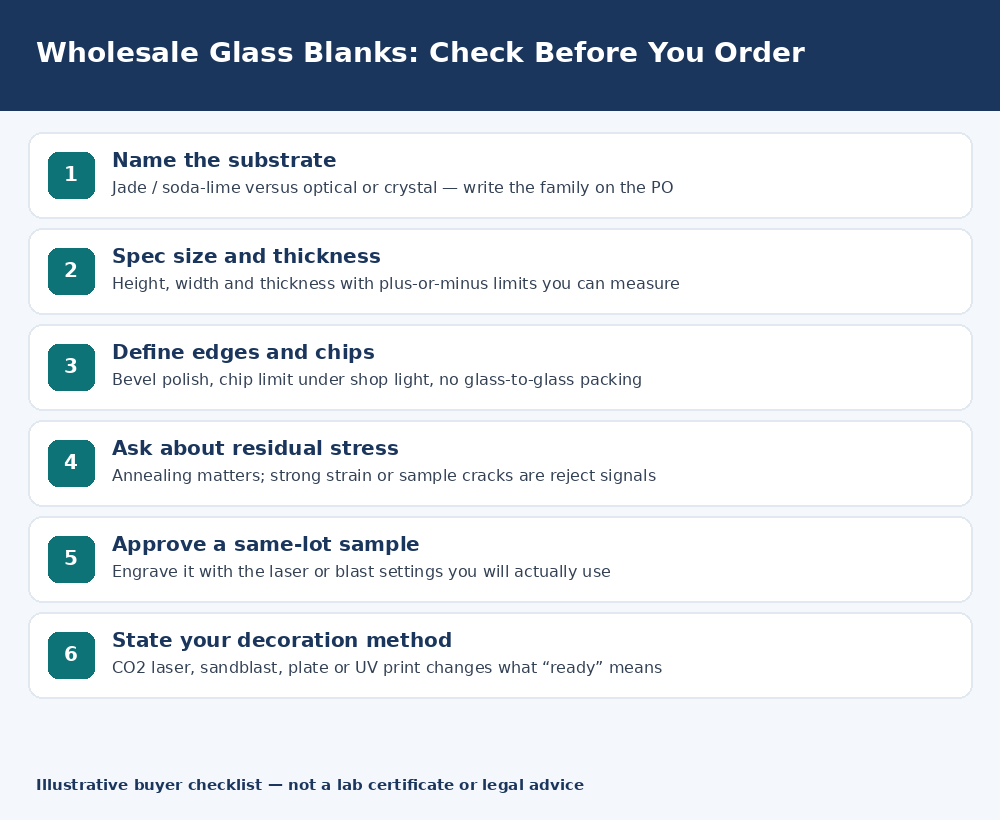
Write material family, size and thickness tolerances, edge and bevel finish, chip and bubble limits, and require one blank engraved on your own equipment from the same lot before bulk ships.
Put numbers where adjectives used to be
Wholesale blank programs fail in quiet ways: a half-millimeter thickness shift that throws off a laser focus or clamp, a raw bevel that chips in the carton, or a lot with leftover cooling stress that cracks when you heat the face. I ask shops to write checks they can perform with a caliper, a straightedge, a bright light and one decorated sample—not “good quality” or “sparkly.”
A practical purchase-order line set looks like this:
- Substrate family and colour (for example, jade glass with a green edge; clear soda-lime; optical or crystal if that is what you are buying).
- Overall size and thickness with plus-or-minus tolerances you will measure on arrival.
- Edge and bevel specification: polish grade, bevel width, and whether the engraving face should remain unprotected raw glass or carry a coating.
- Visual limits: chips, scratches, seeds or bubbles, and colour banding, especially along bevels where clients look first.
- Stress and annealing: because residual stress can appear as double refraction and raise breakage risk, ask whether the lot was annealed and keep the right to reject pieces that show strong strain under polarized light or that crack during an agreed sample decoration.
- Sample gate: one blank from the production lot, decorated with your process, photographed under your shop lights, and kept as the reference.
- Pack: unit sleeves or separators so bevels do not kiss in transit; presentation boxes if you resell immediately.
We offer sample trials before mass production; use that gate on your actual laser or blast settings, not only as a desk ornament. Our multi-stage quality checks can include pre-shipment photos and videos so you can compare the bulk lot with the approved piece before it leaves. Damaged or defective pieces are replaced free with the next shipment after photo or video proof. That after-sales path still works better when the purchase order already defined the chip and size limits you will photograph.
See customized blank jade glass awards for engraving for a typical jade blank silhouette, and write the same fields even if you prefer a clear blank glass trophy.
| PO field | Example checkable language |
|---|---|
| Size / thickness | Height × width × thickness in mm, with stated plus-or-minus limits |
| Edges | Polished bevel; no chips visible at about 50 cm under shop light |
| Clarity | No seeds on the logo face; reject bubbles beyond an agreed size |
| Sample | One same-lot piece approved after your engraving |
| Pack | Individual separator; no glass-to-glass contact |
How Do In-House Engraving Methods Change Which Blanks You Should Buy?
The same blank can succeed under a CO₂ laser and fail in a sandblast cabinet—or the reverse—because the two processes stress the glass differently.
Prove your actual process on a sample from the shipment. CO₂ lasers deposit energy at the glass surface; abrasive blasting adds dust and impact hazards that your shop—not the supplier—must control.

CO₂ lasers heat the surface because glass does not transmit that light
Typical soda-lime float glass, according to the National Glass Association, has essentially no transmission in the far infrared around 10 μm. A common workshop CO₂ laser operates near 10.6 μm, so on soda-lime family award glass the beam is absorbed at the surface rather than passing through like visible light. Combined with the brittle, flaw-sensitive fracture behaviour described in the same paper, that makes laser decoration a thermal-and-surface process: power, speed, focus and the condition of the face all matter. Settings you dialled in on last year’s optical piece will not automatically transfer to this year’s jade lot.
I therefore treat “laser-ready” on a quote as a claim to verify, not a specification. Engrave the sample from the shipment, inspect the frosted mark for chipping along the stroke and for any run that starts a crack from an existing bevel flaw, and lock those settings to that lot.
Sandblasting adds a shop-safety decision, not only an aesthetic one
Abrasive blasting can cut a deep, painterly etch that many corporate clients still prefer. It also creates dust and noise. OSHA’s fact sheet on abrasive blasting notes that silica sand (crystalline) can cause silicosis, lung cancer and breathing problems, and that even glass beads or crushed glass have the potential to cause lung damage. Employers are expected to identify hazards and use engineering controls such as substitution, blast cabinets or rooms, and ventilation; respiratory protection is required when controls cannot keep exposures below permissible limits.
OSHA’s general-industry respirable crystalline silica rule (29 CFR 1910.1053) sets a permissible exposure limit of 50 µg/m³ as an 8-hour time-weighted average. It also says that where abrasive blasting is conducted using crystalline silica-containing blasting agents, or on substrates that contain crystalline silica, employers must follow the silica standard’s engineering-control duties and other applicable rules such as the ventilation standard. This is not legal advice, and a trophy-shop cabinet is not a shipyard blast hall—but if you sandblast blanks in-house, the control plan is part of the buying decision. A cheaper blank that you cannot decorate safely is not cheaper.
Match thickness and fixturing to the method
Laser beds and blast stencils punish thickness scatter. Ask for a thickness tolerance you can measure, and reject lots that rock on a flat fixture. If you only UV-print or apply plates, you may accept a different edge standard than a shop that deep-blasts every face.
If you are unsure which path fits a design, contact us with your method (CO₂ laser, diode, rotary, sandblast or print), the artwork size, and whether leftover blanks must remain unbranded. We can then recommend a blank from the glass award catalog rather than guessing from a photo.
| Method | What to demand on the blank | What your shop must control |
|---|---|---|
| CO₂ laser | Consistent thickness; clean face; prove settings on the lot | Heat input that does not start edge cracks |
| Sandblast | Maskable faces; chip-free bevels | Dust, media choice, cabinet or ventilation, and PPE |
| Plate or UV print | Flat face; cosmetic edges | Adhesion and print profile, not etch depth |
Conclusion
Specify the substrate, prove your engraving process on a same-lot sample, then scale MOQ only for blanks you can actually decorate and resell.
